• I bloody love David Lynch

    What did Jack do? on Netflix

    A detective interrogates a monkey who is suspected of murder

    What did Jack do?

    No one but David Lynch. Love it – and I haven’t even watched it yet.

  • Dracula by Bram Stoker

    Selected Quotes

    Then came another rush of sea-fog, greater than any hitherto โ€” a mass of dank mist, which seemed to close on all things like a grey pall, and left available to men only the organ of hearing, for the roar of the tempest, and the crash of thunder, and the booming of the mighty billows came through the damp oblivion even louder than before.

    from Chapter 7 โ€” cutting from the dailygraph

  • Selected quotes from Meditations by Marcus Aurelius

    This collection is currently not finished – still picking out my favourite quotes. ๐Ÿ™‚ โ€” 14th January 2020

    It was the critic Alexander who put me on my guard against unnecessary fault-finding. People should not be sharply corrected for bad grammar, provincialisms, or mispronunciation; it is better to suggest the proper expression by tactfully introducing it oneself in, say, one’s reply to a question or one’s acquiescence in their sentiments, or into a friendly discussion of the topic itself (not of the diction), or by some other suitable form of reminder.

    Meditations, Book 1 โ€” Paragraph 10

    Wrong, wrong thou art doing to thyself, O my soul; and all too soon thou shalt have no more time to do thyself right. Man has but one life; already thine is nearing its close, yet still hast thou no eye to thine own honour, but art stalking thy happiness on the souls of other men.

    Meditations. Book 2 โ€” Paragraph 6

    Never value the advantages derived from anything involving breach of faith, loss of self-respect, hatred, suspicion, or execration of others, insincerity, or the desire for something which has to be veiled and curtained.

    Meditations, Book 3 โ€” Paragraph 7

    If the inward power that rules us be true to Nature, it will always adjust itself readily to the possibilities and opportunities offered by circumstance. It asks for no predeterminate material; in the pursuance of its aims it is willing to compromise; hindrances to its progress are merely converted into matter for its own use. It is like a bonfire mastering a heap of rubbish, which would have quenched a feeble glow; but its fiery blaze quickly assimilates the load, consumes it, and flames the higher for it.

    Meditations, Book 4 โ€” Paragraph 1
  • 1917

    Time is the enemy.

    The tagline from 1917

    1917 is the incredible film from Sam Mendes about two friends tasked with delivering an important message to save a battalion..

    Presented in one single take, or two depending on whether you count some unconscious hours as a cut, this film is a modern testament to stellar film-making.

    The Plot

    1917 centres around two friends stationed near the front line in world war one France. They are given the near-impossible task of taking an urgent order through no-man’s-land to the Front where a batallion of 1,600 men are about to run into a German-laid trap. Of course that is unless these two friends can get there to warn them in time.

    The story takes us, every single step of the way, through some of the most brutal, and at times beautiful, war-time landscapes. Along the way they meet other people who happen across their path, some friendly; some hostile, but neither stop them on their forward momentum to deliver their message of utmost importance.

    My Thoughts

    I’d heard from a few different people that this film was really good and demanded being experienced in a cinema. In all honesty I maybe wouldn’t have gone to see this, at least not on its weekend of release, however, my lady wanted to watch it so we went this weekend.

    It was absolutely incredible.

    The first thing that I couldn’t help but notice was the impressive single camera shot opening (no visible editing cuts), which I only realised about five minutes in.

    But that opening shot was more than just an opening shot – it became apparent to me that this was going to be a film that would be experienced in a single, unflinching scene!

    (I used to read up on films before seeing them when I was going through my media-student phase. But I much prefer it now, where I know next to zero about films before I go in – save for perhaps what is in the trailers.)

    Yes there would have been cuts throughout the film* – no film is going to be physically filmed in one single take, at least none have been to my knowledge. However, using some clever techniques, many of which no-doubt inspired by Alfred Hitchcock’s 1948 film Rope, director Sam Mendes has managed to pull off the same one-take effect but on a much grander scale.

    Beautifully shot

    The cinematography in this film was stunning to say the least – thanks to the film’s cinematographer Roger Deakins. From the close-ups of decaying corpses of both human and animal alike – half buried in the rubble and mud of battles past – to the wide-shot bold imagery taken against very grand battle-torn vistas.

    This film managed to bring to the screen all manner of brutal war imagery. Some I could have perhaps imagined, but also definitely some I could never have imagined.

    And the lighting! The lighting effects in some of these scenes just made my jaw drop, at least in my mind. One particular time was the beginning of the night-time sequence with the flares going up overhead. It looked both gorgeous and like something straight out of hell at the same time – not that the two have to be mutually exclusive.

    There were certain shots I still remember now very vividly, which I thought I would share here. I will create a gallery below when I can get a hold of the shots I want to share – probably when the film is released on DVD/Blu-Ray.

    An Emotional Story

    The story of 1917 is a simple one at heart – deliver this message over there before this time. However, woven into that story is an incredibly strong beating heart that I couldn’t help but be affected by.

    The way that we remain in these people’s immediate vicinity, and experience everything they do, couldn’t help but draw me into their lives. And the stories they tell about their homes and their backstory, helped to fill them out more as flesh and blood people – making their hardships even tougher to endure with them at times.

    Other Notes

    Main characters aside, I have to say that Andrew Scott was a stand-out performance for me. He is always enjoyable to watch on screen after I first saw him as Moriarty on TV’s Sherlock. And his role as the laid-back, battle-hardened Lieutenant Leslie was enjoyable too. Albeit if only for the 5 – 10 minutes that you actually see him.

    Thomas Newman’s score was incredible as always, and easy identified with certain sounds I felt reminiscent of from his earlier work on Shawshank Redemption and American Beauty.

    I couldn’t help but think of this film in terms of a computer game, with it’s varying ‘Levels’ and mini ‘Boss Fights’. I don’t mean this as a way to make the film’s techniques sound like a gimmick – after all games are true contenders in effective narrative storytelling nowadays, even more so than many films that are released. Just look at The Last Of Us, to name just one.

    *I could be completely wrong about this, so apologies if I am – I am making some assumptions in this post.

  • Star Wars episode IX : The Rise of Skywalker

    On New Year’s Day I saw my first film of the year โ€” Star Wars : The Rise of Skywalker. In all honesty I was expecting to not like it all that much, mostly due to reviews and comments I’d heard from people I know.

    But you know what? I really enjoyed it. It was a fun and visually stunning two-and-a-bit-hour romp across the galaxy. A true good versus evil tale that left me feeling like I’d had a good time at the cinema. And that is precisely what I was hoping for.

    If I’m honest I was hoping for more fight scenes with Rei and Ben as allies, like in the previous film The Last Jedi.

    The one thing that really did take me out of it though is the kiss between Rei and Ben right at the end. I didn’t feel that it was needed at all, and just felt weird to me. Is there really a need for the climactic kiss in every film?

    But on the whole I really enjoyed it. I’ll probably watch it again whilst it’s on at the cinema.

    As an aside, I don’t get why there is always a group of people who lose their shit when something in the Star Wars universe doesn’t go how they thought or wished it would. People who presumably consider themselves “true” fans or “die-hard” fans. To those haters I’d just like to say either get over your sense of entitlement or just watch a different film.

  • Animal Farm by George Orwell

    All animals are equal. But some animals are more equal than others.

    A single commandment

    The story of Manor Farm and the animals who revolt after being inspired to fight for a better life. But those who assume command inevitably become the enemy of the society they are trying to create.

    Animal Farm is a story that I was already aware of before reading โ€” like many other people no doubt. I was aware of the rough idea of the animals taking over Manor Farm and eventually becoming a particular type of society. But even knowing this, I still enjoyed the book so much that I read it in two sittings pretty much.

    The language of the book was pretty simple and to-the-point โ€” language that is too fancy and, dare I say it, flamboyant, tends to throw me off the story sometimes. But yes, Animal Farm delivered it’s message in a straight-forward and to-the-point way.

    I’m not sure if it was Orwell’s intention, or whether it was just my imagination working over it, but my internal pictures of the farm become more and more lacking in colour as it moved towards its conclusion. I pictured the farm and it’s inhabitants in a darkened black and white as they toiled over their labours towards the end.

    The pigs in the manor house, however, I pictured in full colour as the other animals watched on on that final scene from the window.

    I found some similar themes as I remember from Nineteen Eighty Four too. Namely the idea of rewriting history to suit the narrative being created by the ruling class. And then those under the boot just believe that they themselves must have been mistaken when originally reading their seven commandments.

    I knew that there was a reason this book was regarded as a classic. Now I understand why.

    Other book covers

    Here’s a collection of cool covers for Animal Farm that I’ve found. These could get added to over time if I stumble over some more.

    Pink Floyd’s Animals

    Animals by Pink Floyd is one of my favourite albums ever made. Definitely in my top 10. Until I read Animal Farm I hadn’t made the connection between it and that album. I mean how could I miss out on the giant inflatable pig and not link that with the pig in power from the book?

    Roger Waters inflatable pig

    Roger Waters, in his recent tours with his own solo band, has kept the spirit of this pig alive with warnings and messages to the people watching. Messages such as “Fear Builds Walls” and “Religions Divide Us“. Roger is one of my favourite artists from both his Pink Floyd-penned albums and his excellent solo material. I must write up my thoughts on his stuff soon.

    There is a decent article here that discusses some of the similar themes between the album and the book. It is written better that I could attempt right now.

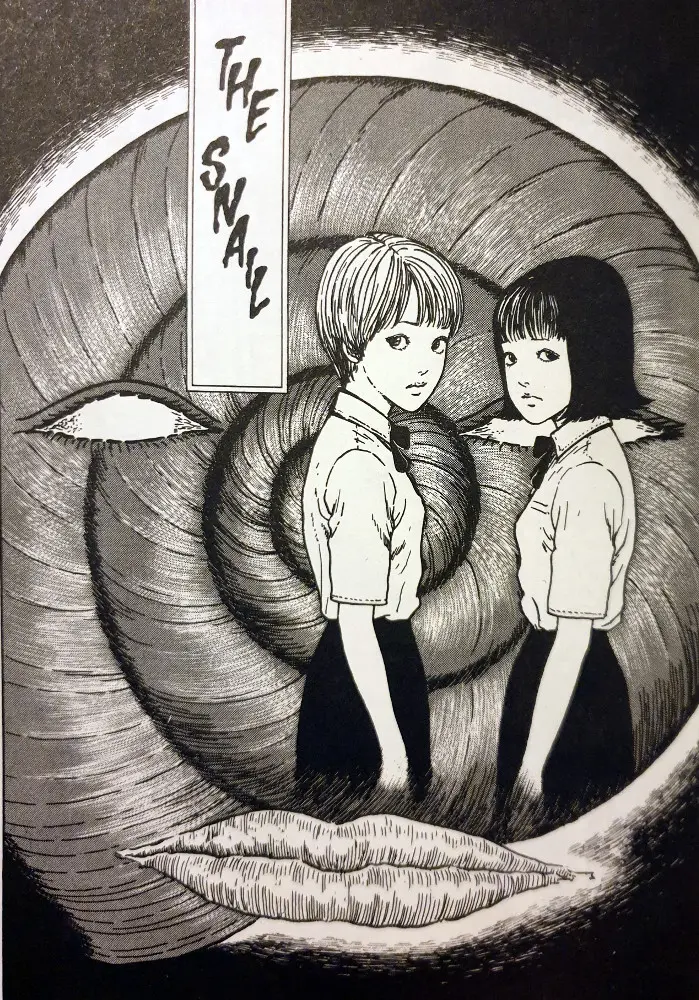
  • The Snail (Uzumaki part 8)

    The Snail (Uzumaki part 8)


    Get off my back! He’s just a slug now! He’s not human anymore!!

    Tsumura justifies himself poking Katayama with a long stick

    The Snail โ€” Synopsis

    Katayama is a bit of a joke amongst his classroom peers โ€” one of which is Uzumaki main-stay, Kirie Goshima. One morning Kirie and her friend remark on how it is raining for the first time in a while, and that they predict that Katayama will come to school that day. Sure enough he walks in, late as always, and slowly takes his seat.

    As each day passes, with the rain continuing, Katayama keeps arriving later. However, his appearance begins to change with each passing day. Firstly a spiral bulge becomes visible from underneath his wet school shirt. Until, by the end of the week, he has somehow managed to transform into a giant snail. Yep, the title of this chapter is very literal.

    Just how will the other school students deal with this very odd turn of events? Will they attack or will they try to help? And what will happen once another one of those very students begins to display signs that they may be going down a similar path?

    The Spiral Rises

    There are two starting points for the spirals in Uzumaki, as I can see. The first is in spirals that already exist in the world. Like with small whirlpools in water, snail shells and in coiled springs. Then there have been the appearances of spirals that have seemingly come from nowhere. Like with Kirie’s hair problems and the girl with the scar.

    In The Snail, we see the latter โ€” a large spiral mark on Katayama’s back seems to point to the origin of his grotesque transformation. Once this mark is discovered, after Tsumura drags a naked and humiliated Katayama into the hallway, the transformation seems to speed up. Presumably, to get the reputation of being slow, it would have to have been a part of his personality for a while before this chapter begins. It’s almost as if the spiral speeds up the transformation process once it is discovered.

    There was one thing I noticed that I found very interesting to note too. Once Katayama turned, and was given sanctuary in the shelter on school grounds, Tsumura starts poking him with a stick. Soon afterwards he himself begins to show signs of slowing down. Then later on, when another character destroys the snail eggs left behind in the woods, they too seem to be targeted.

    I wonder whether the spiral is completely self aware and is actually beginning to target these people out of malice or revenge. If so, it would indeed give some new angles from which to view other chapters in the Uzumaki collection.

    Katayama is bad at sports due to his slowness

    Enter the grotesque

    There haven’t been too many moments in Uzumaki so far, where I have had to squint from disgust. Save perhaps for when Shuichi’s mother stabbed herself in her ears and cut her own finger tips off. But with how Junji Ito manages to capture the depictions of human-sized snails, he almost got me wincing from the page.

    Everything from the bumpy slimy textures of the bodies, to the bulging, elongated eye sockets. Even down to the way he shows Snail-Katayama peeling slowly off the school’s outer wall as he is forced off by students with brooms. These Kafka-esque depictions of spiral-controlled snails display a horror manga artist at the top of his game.

    There was another thing that I found worked at both the grotesque and the dark comedy levels too. The moment when both Katayama and Tsumura, both fully-transformed, are kept together in the pen. They soon begin to mate, as snails do, which brought a whole new layer to the story. Not only are these both young men at heart, or at least they were, they were also the complete opposite of friends. The idea that you have a bully and his victim now mating as human-sized snails, brings a whole new level of horror, and dare I say comedy, that only someone like Junji Ito could conjure up.

    In Conclusion

    I feel like The Snail is more of a mid-level entry into the weirdness of Junji Ito’s worlds. You are safe from the violence and body horror found elsewhere, however, instead you are treated to spine-tingling depictions of gross transformations.

    I think it works really well as a standalone story too. The fact that Katayama is slow by reputation, means that the story doesn’t need to rely on the surrounding spiral nightmares of the town of Kurouzu-cho. This could just as easily be a one-shot nightmare of Ito’s.

    If you are feeling particularly brave you could go in with reading The Snail first. It will give you some great examples of Ito’s artwork and indeed his comedy-aware writing style. Or you could start at the beginning of the Uzumaki Collection and let this one sneak up on you slowly. Give it a read if you think you can stomach it.

  • Death Stranding finished. What an amazing experience. Now time to platinum it. ๐Ÿ˜…๐Ÿ’š

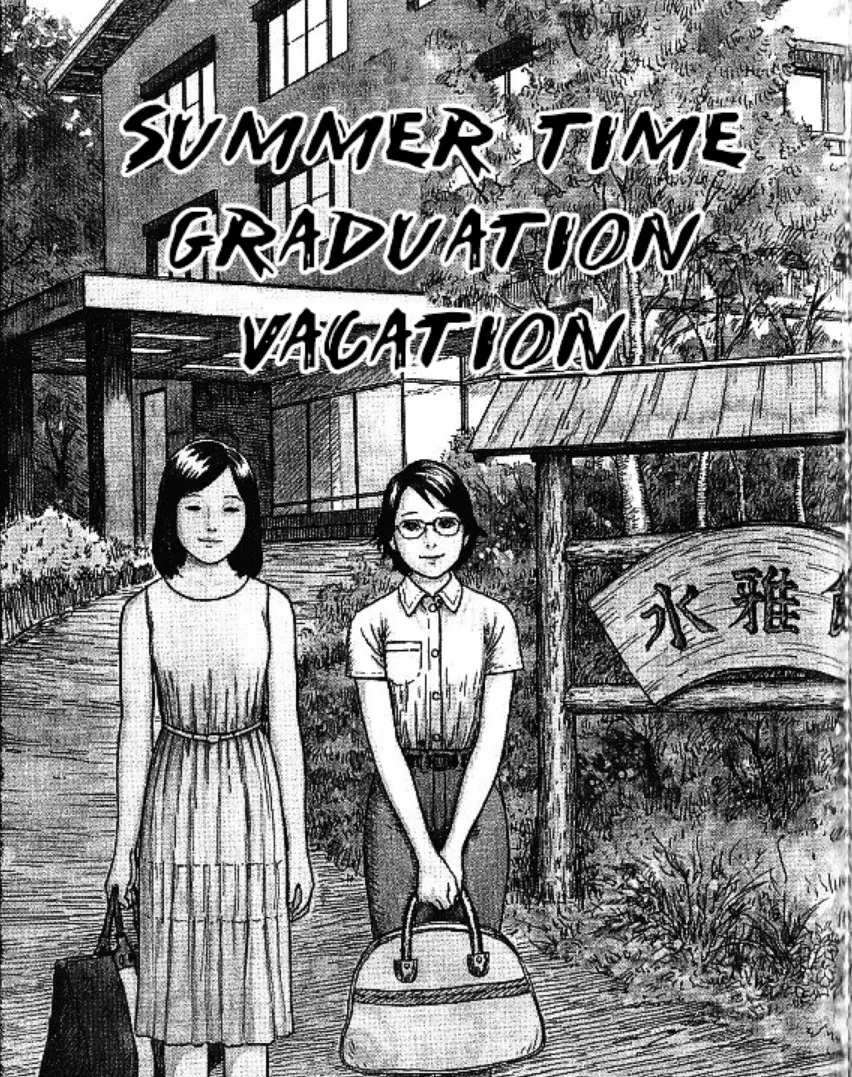
  • Summer time graduation trip

    Summer time graduation trip


    Not a single person speaking… And during the whole time we were there, not a single person got up…

    Hezi describes her experience in the bath house

    Summer time graduation trip โ€” synopsis

    A woman recalls her time after her graduation thirty years ago. During that time, she and a friend took a trip to a holiday inn towards the north-west of the country. The place was relaxing and surrounded by beautiful scenery. However, hidden beneath the inn was a bath house with an eerie secret.

    On arriving at the inn, the pair decide to investigate the local facilities โ€” first on their list was the bathhouse. As they descend the steps towards the bathhouse below, they notice how the stairwell seems to take far longer than it should do to get down. In fact, the further they go down, the darker the bottom seems. Then as they look back up the way they came, nothing but darkness there too.

    Before long, they pass a strange woman who is walking towards them up the steps. This woman is lit only by a small lantern she is carrying. She nods to them that they are heading in the correct direction to the bathhouse. Then as if by magic, they are at the foot of the steps, feeling the steam from the bath behind the door.

    The main character then takes off her glasses before entering the large bath, severely limiting her vision. It is one of those large public steam baths. Sat in the water, she can make out shapes of people close to her, but can make out none of their facial features. She just sees shapes and shadows in the steamy water around her.

    Suddenly, her friend Hezi taps her on the shoulder and urges her out of the water and to leave with her immediately. But what did Hezi, with her much more attuned eyesight, see in the bath’s waters? What was it that the main character could not see? And just who was that mysterious figure in the stairwell?

    Hezi and her friend arrive at the inn

    Almost a ghost story

    At first read, I couldn’t really think of how to approach writing about Summer time graduation trip. You see, it kind of ends just as it seems to begin. We get introduced to the location of the inn, then we see the mysterious lady who passes them in the hall. Following that we get the reveal of the strange people in the bath, all with their heads facing away from the girls. And then just as the inn worker seems to be about to reveal a clue to move the story along, it ends.

    After reading some comments by others, I was introduced to the idea that this could actually be a troll ghost story. In fact, it’s a ghost story where the characters actually make smart decisions and get out before anything bad happens to them. If the story had taken a normal route, then perhaps the maid would have revealed a history of the building and the origins of the lady on the stairs. This would probably have led to some investigation, followed by some trouble with ghosts.

    But what’s almost funny is, is the girl just stops the maid in her tracks and screams “Never mind, Ma’am! […] If we continued to listen to her, it might turn out to be really scary, right?”. In fact, the more I think about this story, the more I’m convinced that it is in fact a comedy. But it’s only a comedy in the punchline, like a dry-witted comedian who you didn’t realise was telling a joke until you find youself laughing at the end.

    The steps seem to go on forever

    Lost potential?

    Although I respect Junji Ito for taking a chance on the story in how he ended it, I cant help but want more of the story revealed. If only the girls had taken the other route, and pursued a line of enquiry that would have inevitably meant risking their lives and possibly their sanity.

    I loved the imagery of the bath house full of people too, all with their backs to the girls. We are left to wonder whether they are perhaps disfigured or dead… or both. Maybe it’s like a nightmare where if they are turned around they would reveal nothing more than the backs of their heads once again.

    And that lady on the stairs too. She seemed like an interesting chaarcter, carrying her small lantern and apparently disappearing up the steps behind them. What was her purpose? Was she some kind of overseer of the dead below? Was she evil? Good? Or maybe an impartial lost spirit just searching for rest?

    Maybe it was all some lost potential for a longer tale? Or maybe it was further strokes of genius from Junji Ito, in letting us imagine for ourselves just what was happening at that inn.

    The bath full of mysterious people

    In Conclusion

    Summer time graduation trip is one of Junji Ito’s manga stories that has had to take time to grow on me. I don’t think I really “got it” on first reading. I may have even thought I didn’t have the complete version โ€” I don’t remember. But it has grown on me and even makes me smile when I think about the ending to this one.

    It’s a risky choice to write a ghost story but then end it before any meaty ghost encounters occur, but if there’s one thing I’ve come to expect from the master is that he isn’t afraid to take some chances. If you want gory or ghosts, or people with seemingly doomed fates, then you can find those aplenty amongst his other works.

    However, with Summer time graduation trip what you are getting is, as I believe, a tongue-in-cheek ghost story. I can even picture Ito watching your reaction as you approach the end, just to see if you get it. I mean, I could be completely way off, but these are just my opinions. Let me know in the comments if you have any other takes on this one.

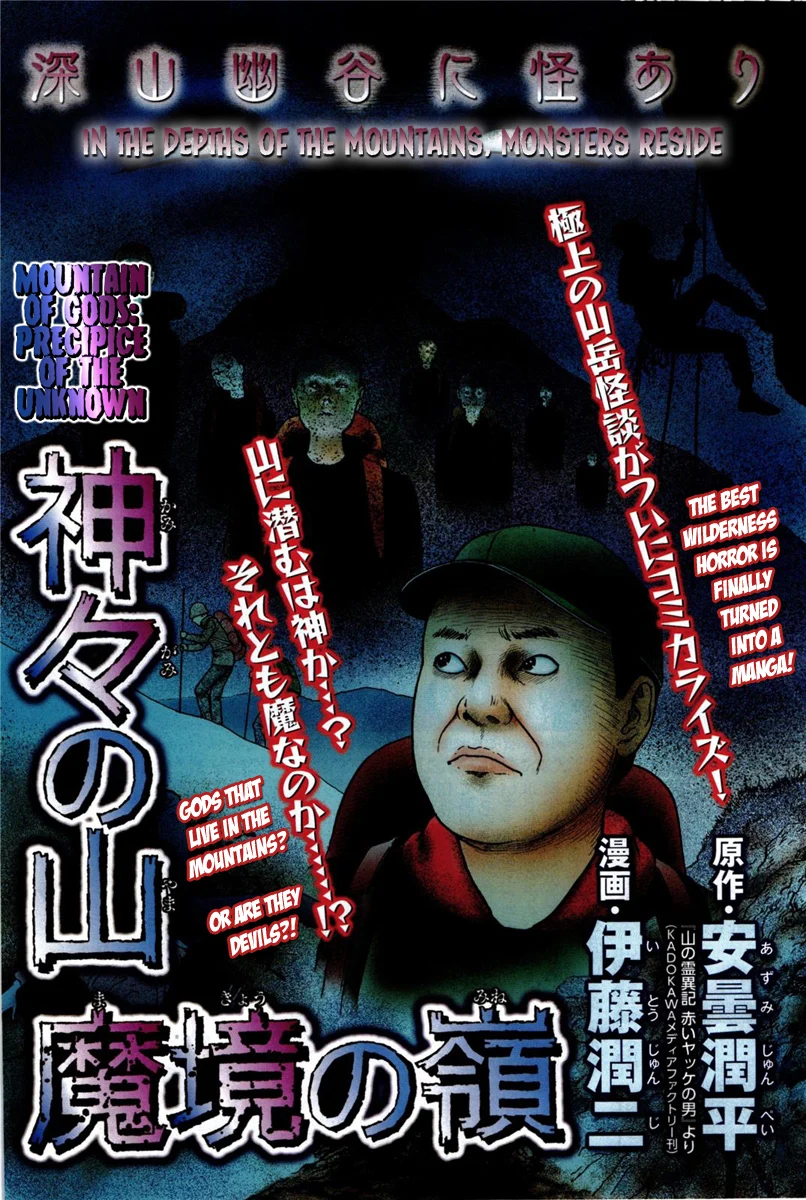
  • Mountain of Gods: Precipice of the Unknown

    Mountain of Gods: Precipice of the Unknown


    That man wasn’t smiling. He was sneering at me with immense hatred.

    Ishida describes his encounter with The Sneering Man

    Mountain of Gods โ€” Synopsis

    This story tells of three hikers who are comparing their past hikes with one another. However, the story soon veers into the spooky as the subject of a recently-missing woman hiker comes into the conversation. All that they know is that she went out hiking from the same cabin they now sit in, happy as can be – according to the cabin manager, but who was discovered dead at the foot of a snowy drop.

    This brings to mind eerie encounters that each of them has had on their past hikes, which they each describe in turn. One tells of becoming alone on a mountain-top path before seeing a very thin, sneering man coming towards him at an unnatural pace. Another tells of a similar face pressing its way through his tent, Freddy Krueger style.

    But will the mystery of this sneering man (is it even a man?) or the death of the lady hiker ever be solved?

    Ghost stories

    I think that this story is supposed to do what nearly all ghost stories do. It tells of an unnatural occurrence with some malevolent force, but never gives any explanation of it. This is told purely from the perspective of the hikers in the cabin and their own memories and imaginations on what they think could have happened. We are left to wonder whether there even is such a person as the sneering man, or whether it is a common hallucination from being up so high in the altitude.

    It felt almost light in content when I first read it, partially due to the static nature of the main characters. But as I re-read it multiple times, the grimacing face of the sneering man began to grow on me. And once I learned it was actually part of a larger anthology from multiple artists, it all came together. Although I do enjoy this for what it is, a short ghost story about a hiking urban legend, I believe that it would sit much better when read along with the other stories in its collection.

    Ishida tells of his past hiking experiences

    I haven’t been able to find any of the other chapters from the Yama Kaidan anthology. All I know is that it is a collection of mountain-related ghost stories about gods or demons that could live in the mountains. If you find any of the other chapters, please do let me know in the comments below. Thank You. ๐Ÿ™‚

    The Sneering Man

    The Sneering man, like Fuchi from Fashion Model, is a character that I would love to see much more of. It’s almost teasing that we get the short glimpses of this person in Mountain of Gods.

    Despite this being a lesser-known Junji Ito work, I think it is one of the best examples I’ve seen of him slowly revealing horror on the page. If you look at the first glimpses of the sneering man, and the switching between it and Ishida as they get closer, the way in which the true nature of the strange figure is revealed is incredible. The way that the smile reveals slight arching in the corners of the mouth as it comes into focus. The darkening of the facial features as the distance between them shortens. Then that horrific grimacing full-page face that almost scares you out of your seat.

    A big part of me is always glad when a menacing figure such as this remains mysterious. There’s nothing worse than having everything explained to you when your own imagination can be so much scarier at times. But there is a small part of me that would kind of like to know where this sneering man came from.

    In Conclusion

    Mountain of Gods: Precipice of the Unknown is a great short story to give you the creeps before bed time. The character of the Sneering man will surely stick with you after reading โ€” I think that face is almost etched on the back of my eyelids. ๐Ÿ˜€

    Due to it’s minimal graphic horror, I think this would be perhaps a good introduction to Junji Ito’s work, for those who haven’t read his stuff before. I mean, it in no way represents the crazy imagination that you will find in say, Uzumaki or Tomie. But if you are looking to tread lightly into Ito’s world, this could be a good choice for you.

    I’ve only been able to find this story in a translated version for my own language on Manga Rock. But please always support Junji Ito where you can by buying his official works.

    Be careful when you go out walking…

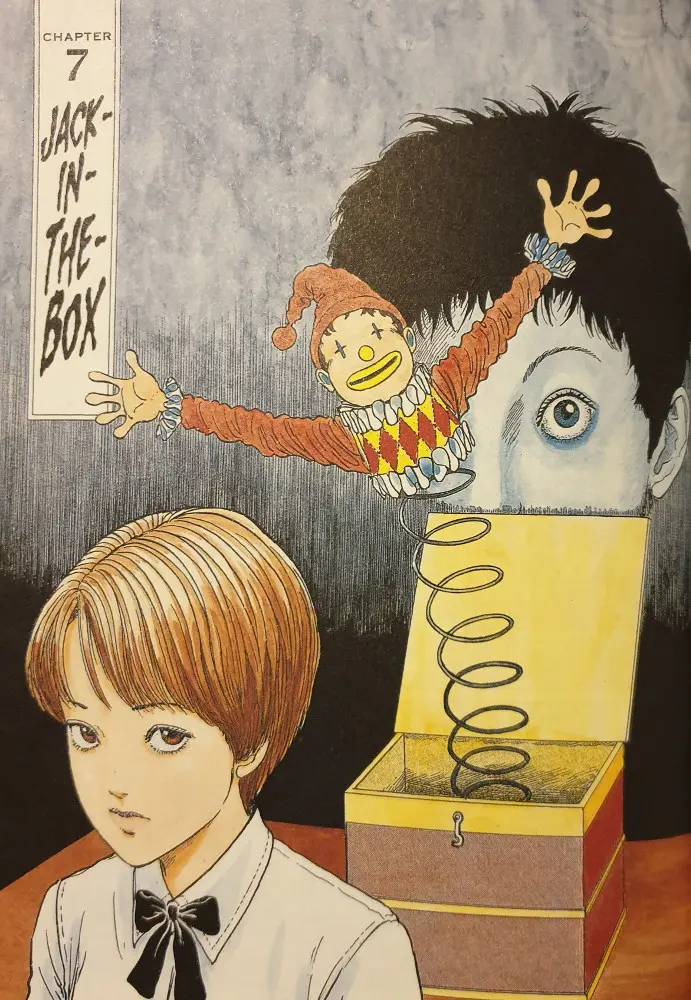
  • Jack in the box (Uzumaki part 7)

    Jack in the box (Uzumaki part 7)


    My love for you will stop this car!

    Mitsuru believes strongly in his love for Kirie

    Jack in the Box โ€” Synopsis

    Kirie Goshima has an admirer, and an annoying one at that. His name is Mitsuru Yamaguchi and he has a very frustrating habit. He keeps on jumping out and surprising Kirie at moments when she least expects it. One such time is during the walk home from school with her friend Shiho. Shiho warns him off, but he continues to annoy Kirie nonetheless. For him, this is how he shows his love for her.

    After a little time, he decides to send Kirie a present in the mail. However, instead of opening it she decides to meet up with him to return the gift. He seems sincere in his affection at this point and decides to prove his love once and for all. Declaring that his love is strong enough to stop traffic, he jumps out into the path of a moving car. A final jump that sees his body wrapped around the front wheel of the unsuspecting driver.

    After Mitsuru’s funeral, Kirie is wracked with guilt over his untimely death. But it may not be the last she has heard from him – this is Kurouzu-cho after all. The spiral is ever-present and can make all sorts of things possible.

    One evening while talking through the grief with her boyfriend Shuichi, she gets a terrifying vision from the gift that Mitsuru had left her. She discovers that the present is a very apt one for it’s sender โ€” it is a Jack in the Box. The Jack in the Box seems to tell her that his death was indeed her fault. And not only that, but that Mitsuru will come back for her too.

    Deciding to find out the truth behind the Jack’s whispers, and to try and rid her head of its voices, Kirie and Shuichi take a shovel to Mitsuru’s grave to ensure he is in fact dead. But they are not prepared for what they find in the ground.

    The subtleness of the Spiral

    When seen from above, a coiled spring will display the shape of the spiral. Not only that but the spring can also represent the releasing of stored energy. This idea could well be what gave birth to the character of Mitsuru. But it isn’t until the closing pages when this becomes apparent. Once you’ve read it once, the spiral can be seen throughout this chapter. He is the metaphorical coiled spring jumping out at Kirie again and again. But until you’ve read it, the spiral is indeed subtle.

    Inanimate objects with human likeliness always have the potential for horror. Just think ceramic dolls and old toys in the attic. But what I loved in this chapter was that not only did Junji Ito manage to depict an otherwise innocent Jack in the Box as demonic and foreboding. He also managed to have it perfectly represent the key character, Mitsuro.

    The spiral has had a very visual presence in the town so far. It has appeared in cremation smoke, pottery and even throughout victims’ hair. But this is perhaps the most subtle that the spiral has been up till now. In fact, I would be so bold as to say that this chapter could almost be read outside of Uzumaki altogether.

    The way in which Ito ties the character of Mitsuru to that of a Jack in the Box was a stroke of genius. Especially when he later makes use of the spring from the car that killed him to make his complete transformation. Yes, the spiral is present in the springs throughout, but take the spiral obsession out of the equation and you still have a strong horror nightmare with an almost self-fulfilling prophecy.

    Mitsuru believes his love for Kirie can stop a speeding car

    Coiled up terror

    As I began writing up my thoughts on ‘Jack in the Box’, I began to notice how the chapter’s structure itself felt just like a coiled spring. With each unwanted jump scare from Mitsuru winding up the metaphorical coil until he is stopped dead in his tracks by that car. That impact and his winding quickly around the front wheel of that car are the first glimpses of horror we see, and the first release of the coiled spring of the chapter.

    Once the funeral is done with, Kirie’s descent into guilt and the foreboding presence of the Jack in the box toy, wind up the chapter’s final spring. It is wound up tightly and held with each step that her and Shuichi take through that graveyard. Until those final pages and the explosion of energy that shoots out towards them. The second spring is released and the two of them are directly in its path.

    I may be reading too much into these stories, and perhaps seeing things that I want to see, but that is precisely why I’m writing these thoughts up. I just love seeing what my mind can find beneath the surface of Ito’s work โ€” and as I have quickly come to realise, there is always more to find beneath his expertly-drawn panels than meets the eye.

    In Conclusion

    Jack in the box is definitely a chapter that can be enjoyed on its own and without any prior context to the preceding Uzumaki chapters. Yes, there are mentions of the spiral cremation smoke trails from The Spiral Obsession opening chapters, but they are only mentioned in passing. And they are not needed to be fully understood for this chapter to be enjoyed.

    Jack in the Box is one of my favourite chapters from the Uzumaki collection. Something about the character of Mitsuru and the enjoyable absurdity of his constant jumping out at Kirie have stuck with me. I think that, along with the following chapter The Slug, are images that have stayed with me the strongest since my first time reading Uzumaki some years ago.

    One of the great things about this chapter for me, was how it is almost ambiguous in its final half. With both Kirie and Shuichi having already come face to face with the spiral, who’s to know if what they experience in that graveyard is real? (it probably is).

    Was it just a nightmare? Who knows? (probably not). But one thing is for certain – Junji Ito sure knows how to tell one hell of a great story.