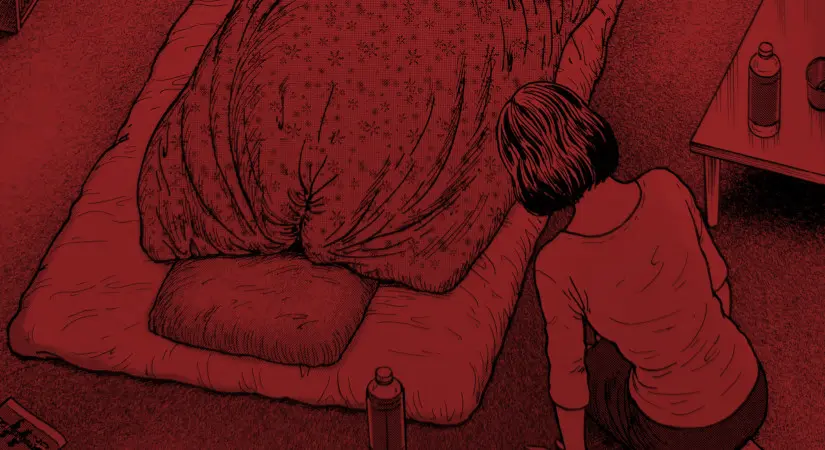
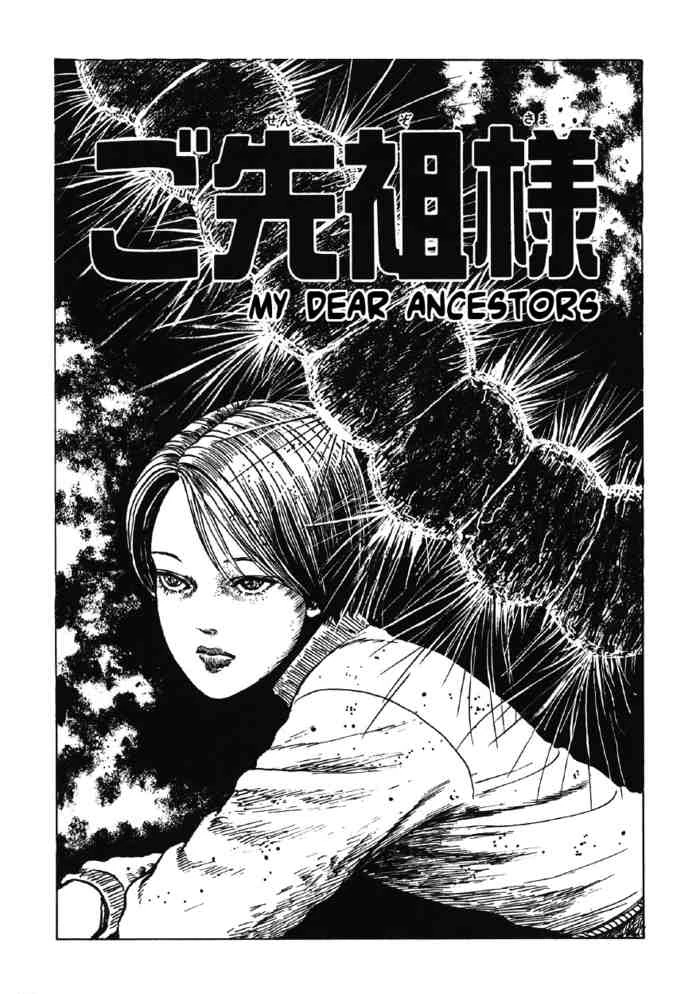
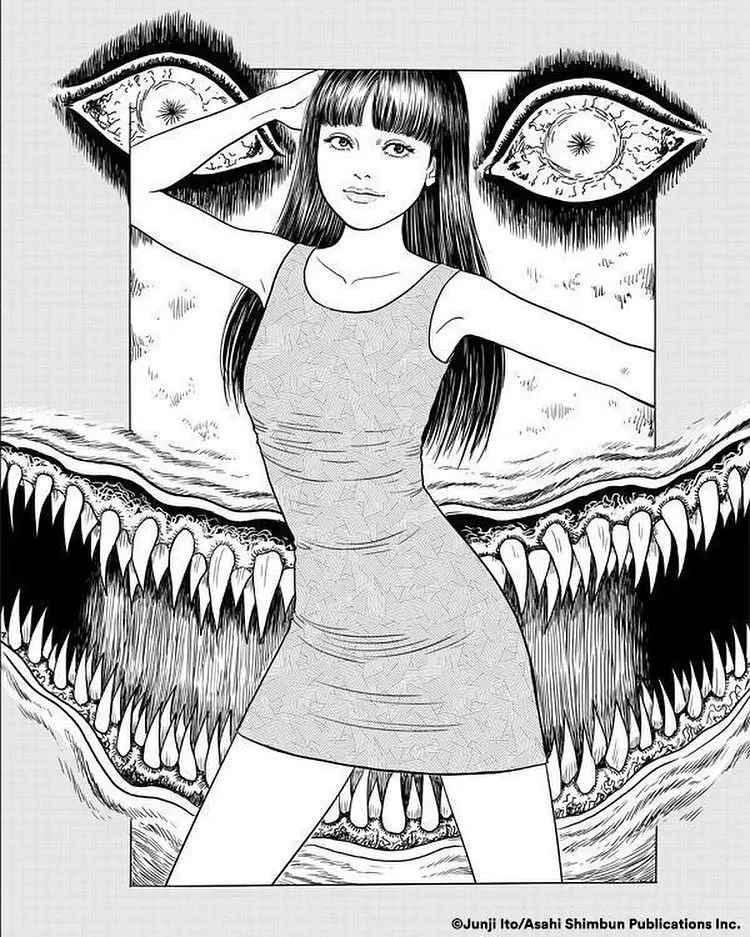
Junji Ito

Blackbird

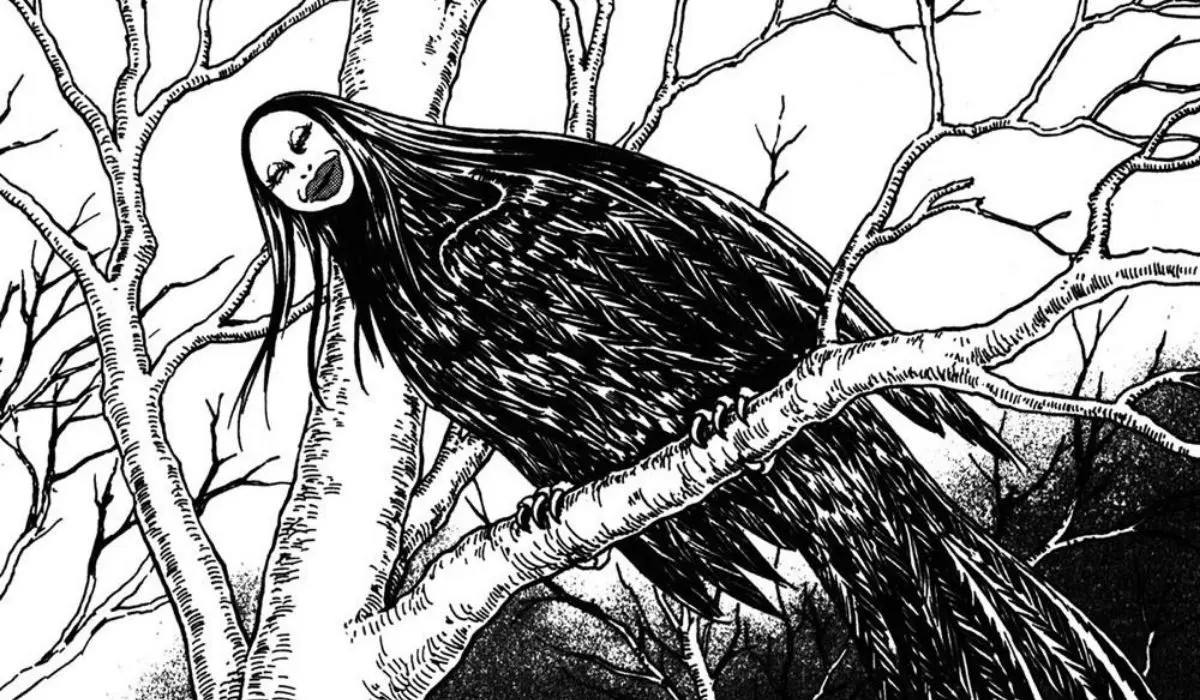
Just who, or what, is this woman who has been helping, and still continues to help, Moriguchi in this very odd, stomach-turning way?

Blackbird — Synopsis

In Blackbird, we join a young man who is bird-watching alone along a beautiful stretch of a mountainous forest. This man’s name is Kume. Along his walk he comes across another young man who is lying injured amongst the foliage — his name, Moriguchi. It seems that Moriguchi has broken his leg, and has managed to survive for a month or so on nothing but the rationed food from his own backpack.

However, as the story continues we learn the deeper, darker truth to Moriguchi’s survival. On the first night of his rescue, he asks his new friend Kume to stay in the hospital room with him. He doesn’t give a specific reason, only that he is scared. That fear is soon realised by Kume during the night, when he witnesses a long black silhouette of a figure kneeling over Moriguchi with its face pressed against his.

On a closer look, Hume sees that the figure is a tall woman with empty, dead eyes and puffed-up lips. After she has made her swift exit, Moriguchi wakes and coughs up a huge chunk of raw flesh. The raw flesh having been fed to him from the mysterious woman’s mouth to his; bird-style.

Just who, or what, is this woman who has been helping, and still continues to help, Moriguchi in this very odd, stomach-turning way? Why did she choose to help him as he lay injured on that forest floor for a month? And will he ever be able to escape her shadow and her bird-like ways?


I’ve been rescued… but She came… but I don’t need the meat anymore…

Moriguchi wants the strange woman to leave him alone

A Faustian-like nightmare

This story had the air of a faustian tale for me. A sort of “deal with the devil” in exchange for something that must be later re-paid. Re-paid with one’s soul and eternal damnation.

The only difference here between The Blackbird and the more classical faust-inspired stories, is that Moriguchi seems to make this deal subconsciously during his fear for his life. As opposed to the more well-off people of a classical faust story; People who just want more knowledge and / or power.

At least this is my interpretation.

His own fear for losing his life could have somehow summoned this woman — this devil. The woman then taking him into a strange, almost recursive, nightmare from which he can never escape. But it’s only on finishing the story do you realise just how sealed Moriguchi’s fate really is.

After we discover that it is in fact his own flesh, somehow from his future, that is being fed to him, I realised that this was a deal that had already been claimed. Yes, she saved him from certain death, but it was from the meat of his own body.

So in essence he saved himself in that immediate moment, but at the expense of his future self.

Moriguchi’s death was always inevitable.

A shadow looms over Moriguchi

An interpretation of Death

Another interpretation I thought about with regards to the bird lady, was that she could be another manifestation of the Grim Reaper; Death incarnate.

The inevitability of death is equal for all living creatures. No matter when or how that time comes, it is something that we all share. So when this woman entered Moriguchi’s life and took him into her twisted nightmare, she did so knowing full well that she would take his life in the future.

In fact, from her point of view she had already begun.

When you think about it, Moriguchi was already about to face death, regardless of the woman appearing. So in fact, she actually gave him more time on the living earth.

Is the demonic winged lady truly an evil being? Could she even be responsible for Moriguchi’s initial state of injury? Or could she actually be something of an agent for good?

Here’s a thought — what if she was some sort of angel, with the power of life and death. What if she was actually trying to give Moriguchi a bit more time in the world?

Perhaps she knew that when death decides it is our time, then it is indeed our time. But maybe she had the power to prolong that person’s life, if only for a short while. But in doing so knew that the life in question was already chosen and must inevitably be claimed.

In Summary

The Blackbird was one of the first of Junji Ito’s stories I remember reading. It was one of the ones contained in the first of his collections that I bought — Fragments of Horror. And despite the fact that I have read a decent portion of his work up till this point, it still remains one of my favourites to go back to.

It’s a circular nightmare that I love to re-enter again and again. The imagery of the blackbird woman leaning into Moriguchi on the hospital bed is one of my favourites of Ito’s. Although the panel itself isn’t hugely detailed — especially the woman herself, being only a silhouette to Kume’s eyes — I just remember the sense of wonder I got on my first reading.

Being fresh to Ito’s work at the time it was something that really opened my eyes to his work and was one of the main catalysts in my wanting to actually write about that work. Too bad it’s taken a few years to actually get round to writing about this one.

Fragments of Horror is an incredible smaller collection of stories and I fully encourage you to take a look — if only to read the awesome story that is Blackbird.
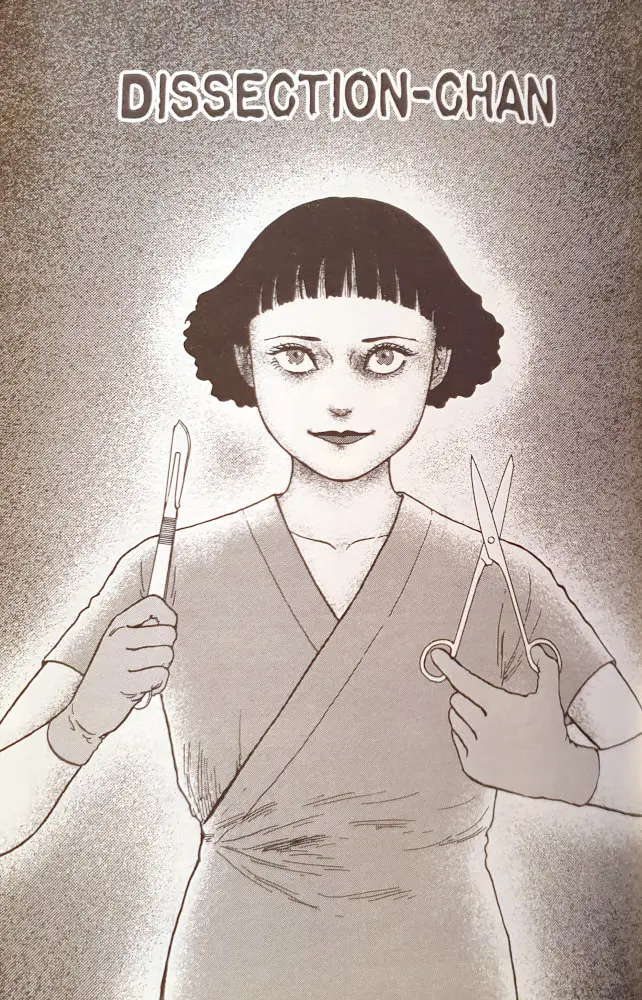
Dissection Chan (Dissection Girl)

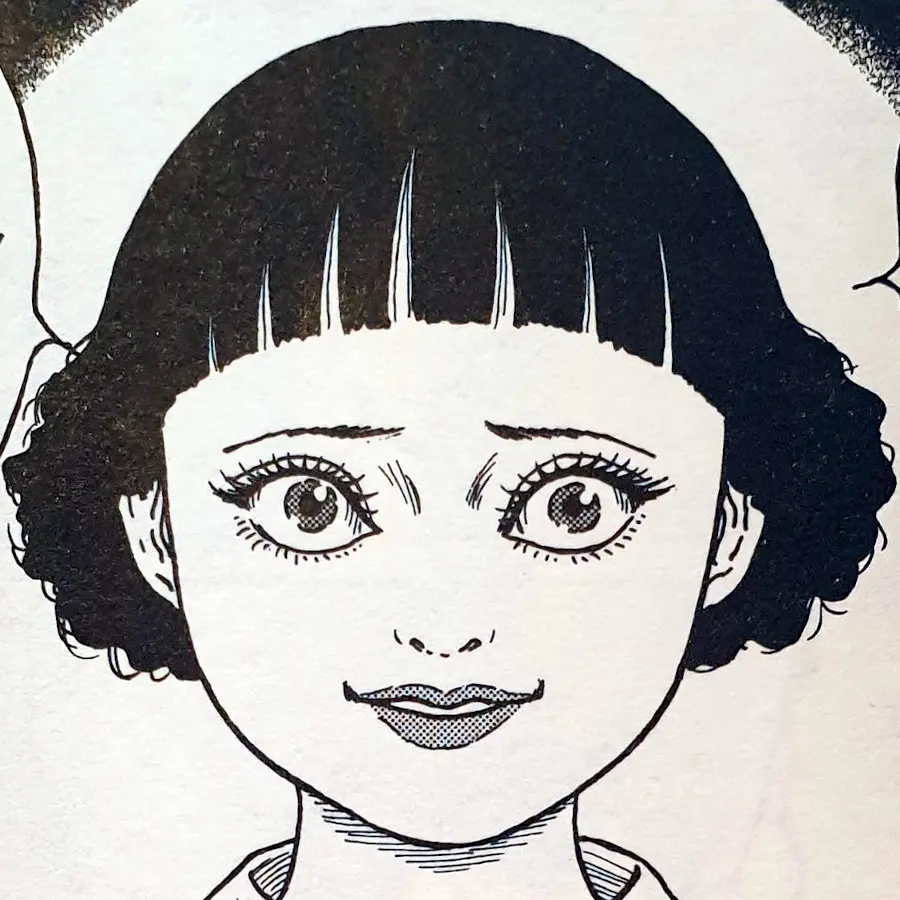
A young woman has a dream… to be dissected. Something inside her yearns to be cut open and studied…

Dissection Chan — synopsis

At a local hospital a group of medical students are preparing to start their curriculum on the dissections of cadavers. As each of the student groups opens their body bag they find the old, frail bodies of the dead. People who have graciously donated their bodies to the advancement of medical science.

However, there is one group who conversely find a fresh-faced young woman. Fresh- faced enough that she could almost be mistaken as being alive. And then when she twitches a smile and opens her eyes, the students are stunned. They are greeted by a young woman who is begging to be dissected!

She soon runs out of the theatre laughing to herself. The students are left in shock. All except one, who is sure he recognises the woman from his past. This trainee doctor’s name is Tatsuro Kamata. But just how does Tatsuro know this woman? And where will she appear again?

Journey of a psycho

Dissection Chan is, for me, one of the more disturbing stories by Junji Ito. It is also incredibly original and takes a common backstory of psychopaths and gives it an interesting spin.

When hearing those common backstories, especially in criminal investigation programmes, psychopaths often have a similar backstory. They would normally have been known to cut up small insects as children. They will often then graduate to rodents; then sometimes to cats or dogs; before becoming the vicious killer of humans that they are seemingly destined to be.

In Dissection Chan, the title character Ruriko Tamiya journeys along that same path. She begins cutting up frogs, with the aid of a helpless young Tatsuro — the trainee doctor from the story’s opening, and soon gets a hunger for larger animals. Before long she is chasing her friend with a scalpel, looking like she’s almost ready to become the killer she is seemingly growing into.

But what Ito does, very imaginatively, is take those psychopathic tendencies and turn them inwards. Ruriko becomes obsessed with wanting to be dissected herself.

Peek-a-boo Ruriko

Self destruction

Human’s are often described as having a tendency towards self destruction. Now, I am not a psychology student — my levels of psychology knowledge come from films and Derren Brown. Specifically I remember in Terminator 2: Arnold Schwarzenegger saying to John Connor, about human beings, that “It’s in your nature to destroy yourselves”.

I have also discovered this idea in other stories by Junji Ito. The one that springs immediately to mind is The Enigma of Amigara Fault. In it, people are drawn to the pitch black tunnels in an earthquake fault line carved out in perfect human silhouettes.

Just like the people that are drawn to their own holes in the wall, despite it meaning certain doom, so to is Ruriko drawn to her own doom. Being dissected, if not already dead, would definitely kill you, and she is very aware of this. But maybe the very same “Death Drive” exists in her, making the last few panels of this story inevitable.

The sickness inside

The closing panel to Dissection Chan is one of my favourites of all of Ito’s stories I’ve read so far. The insides of Ruriko’s body are like something out of a living nightmare. It’s almost as if the souls of the things she’s dissected and killed over the years have become part of her.

It definitely explains the stomach pains she suffers from.

On a metaphorical level, it feels like it is the sickness inside her that is driving her obsession for dissecting. Something started long ago has being developing inside her. And by the looks of her insides, it is not only driving her to her actions and desires, but it is something she has been feeding too.

It is almost as if her desires in her early days have made way for a biological need to be dissected as of late — in order to let out of her body the rotting, mixed-up living things that have developed inside her.


Well, this is where you come to be dissected, right? I want to be dissected!

Ruriko Tamiya has a very particular taste

Ruriko’s life and her physical body are definitely the result of a very grotesque vicious cycle.

And then there is the sexual deviancy side to it all.

Not only is this woman obsessed with dissection, but in her later years she becomes sexually attracted to it. Soliciting men and begging them to cut her open; then appearing at Tatsuro’s home, as naked as she was on that hospital table, screaming her mantra: “Dissect me!”.

Junji Ito isn’t one to shy away from such sexual scenarios. I remember another character of his from Wooden Spirit, who was depicted as being sexually attracted to the old historical home in the story. Crazy stuff.

In Summary

Dissection Chan is incredible. It touches nerves that you possibly don’t know you have. It may even make you question what is possible in the realm of horror and horror manga.

The depictions throughout the story get disturbing at times, but nothing so disturbing that would put you off any of Ito’s other works.

In fact, I would argue that this story is one of the best examples of an Ito horror manga to give you an appetiser for his other stories. It is definitely one of the first I read in the Fragments of Horror collection, and is one I often re-read as well.

Ghosts of Prime Time

Ghosts of Prime Time introduces us to one of the strangest double acts I’ve ever seen. This double act is a comedy duo, two young women, known together as Tasogare Kintoki.

…but we’re makin’ things happen with our comedy. We’ll take control one o’ these days!!

Tasogare Kintoki says some strange things during their comedy routine

Ghosts of Prime Time — Synopsis

Keisuke and Tsuguo are two friends talking in a small cafe. Tsuguo is an every day regular young man, whereas Keisuke is more withdrawn and “gloomy”.

Tsuguo tells his friend of a story of a recent local killing of an obscure comedian. The comedian was found in the street with an expression of equal parts suffering and laughter.

Later that day, the two friends go to a local comedy club – Tsuguo wanting to cheer Keisuke up – to see the comedy lineup. One of these acts in the line up is the aforementioned duo Tasogare Kintoki.

Tasogare Kintoki are objectively bad at comedy. Their jokes fall flat and most of their banter is regarding how they will one day “make it big” and live in a mansion. A very strange double act indeed.

However, after a few moments of complete silence with the odd whisper, one audience member begins laughing uncontrollably. And then, just as Tsuguo comments on this strange occurrence, another person does the same. The effect starts to repeat through the audience until the entire club is in a vicious roar of laughter. That is, everybody except for Keisuke.

There is no doubt that something is not right in that comedy club, but what is it? Keisuke is the only one not affected, but what does he have that the others don’t? And what might Tasogare Kintoki do when they realise that there is one person seemingly immune to their unique brand of comedy? Their sinister grins promise a future of pain and torment.


Some spoilers below


Horror and Comedy

Horror and Comedy are very closely related. Both genres have a willingness to go over the top with absurdity and exaggeration. While comedy uses it’s exaggerations to poke fun and make its audiences laugh, horror conversely uses it’s own to scare and unsettle its audience.

But what’s often more interesting, at least to me, is when an artist manages to combine the two into something often greater than the sum of the parts. Many people often cite Quentin Tarantino’s famous ear-cutting scene in his first major film, Reservoir Dogs. (Despite never actually seeing the cutting itself, audience members still tending to look away)

What I think Junji Ito has managed to craft here though, is a different way of blending horror and comedy. Instead of taking the elements of both genres to make his story a “horror comedy”, he has actually taken horror and made it infect the comedy inside the story. I am referring to the fact that the laughter and enjoyment apparently felt by Tasogare Kintoki’s audience, is in fact the direct result of the phantoms/ghosts that they project out into the crowd.

I think the blending of genres is always interesting to see. But I especially liked here how Junji Ito hasn’t necessarily blending the genres together. He has instead kept this as a horror story, but used the comedy within the narrative as the vehicle for that horror.

Faces of Comedy

Junji Ito has always been an artist who draws great facial expressions. Especially faces of pain and obsession. In Ghosts of Prime Time, he has on display some brilliant faces of extreme laughter and, of course, pain.

The first example is actually on the very first page — the story of the obscure comedian who is found dead in the street. The close up of his face does indeed show laughter at the time of death. But so to it manages to put across pain and suffering from, I believe, the completely white eyes and taught muscles around the neck and face.

And I can’t mention the faces in this story without mentioning Tasogare Kintoki themselves. Their expressions always that of faces on the cusp of laughter, sometimes without pupils in their eyes. Almost like they are being possessed at times. And despite their smiles, they are always projecting a sinister intent towards all those who see them.

Poker face Keisuke

Keisuke definitely takes on the role as the sane compass centre in Ghosts of Prime Time. He reminds me a little of Shuichi in the Uzumaki collection. Whilst all the craziness is going on around him, he seems to stay grounded and be able to look objectively at those things.

Just as Shuichi seems to be able to detect and know of the spiral’s control within his town, so to does Keisuke in his town. He can see the spirits that leave the bodies of Tasogare Kintoki to tickle the audience into submission. He knows they are not to be trusted and warns his friend of that.

I think these sorts of grounded characters are important to these stories. Without them we would just see the events unfold with no-one really to fight back. But Keisuke does fight back — and with gusto.

In Summary

I really love Ghosts of Prime Time. It doesn’t seem to be as well known or regarded as Junji Ito’s more popular stories like Tomie or The Bully, for example. But I want to change that! This story is, as are most of Ito’s works, wholly unique.

I believe this one would be a perfect first story of Ito’s to read if you were looking to get into his stuff. Especially if you wanted to avoid the kinds of body horror that come with so many of his more celebrated works.

And believe me when I say that it will become a journey for you. Because once you have read this story, you will most likely want to start exploring his other great works too.

Human Chair

The Human Chair begins with a lady asking a furniture maker about buying a chair for herself. After a passionate talk about the importance of a good chair, the Salesman takes her into a back room to show her one particular chair — a chair with a strange past.

…but I have a feeling that there really was a man living in the chair… and he leaves the chair every night…

Is Yoshiko’s paranoia getting the better of her?

What is The Human Chair about?

When a lady author speaks with a furniture maker about getting a new chair, he goes on to tell her the story of an author from long ago, Togawa Yoshiko. Yoshiko had a large, soft writing chair bought for her by her husband — similar to the one that the Young Lady is being shown today.

Yoshiko would often receive letters from new authors in the hope of guidance and / or exposure into the arts. One such letter details the story of a chair maker who decided to build secret compartments into the lining of his chairs — places for him to sit beneath those sat on the chairs.

Yoshiko’s paranoia gets the better of her, and she becomes convinced that her own chair is the one spoken of in the letter. Whether that is the case or not, I will leave you to discover through reading The Human Chair for yourself. What I can say though, is that Yoshiko’s story has a direct effect on the lady author from the start of the manga.

Whether that is good or bad, I will leave you to discover for yourself…

Based on a short story of the same name

In 1925, the short story “The Human Chair” was published in Kuraku literature magazine by Edogawa Ranpo. In Junji Ito’s manga adaptation, he has used the narrative of that short story as his backstory. It is very much a sequel to that original story.

The chair’s history is actually described in more detail in the original short story, I believe. However, in the context of Ito’s interpretation, this isn’t as important. Instead he uses the basis of that original story as a spring board from which to explore the darker recesses of the tale.

Apologies if I am wrong here, but I think I am right in saying that Ito seems to create his own additions to the end of Yoshiko’s legend. The original ends at the point at which the chair-maker’s confession letter turns out to be a short story manuscript from an aspiring writer. However, Junji Ito takes us further into Yoshiko’s paranoia and the horror that may just be hidden beneath her chair’s soft upholstery.

Perhaps the original story was left ambiguous for the reader to formulate those possibilities in their own minds. Here we get to see how Ito interpreted that story, and just how he imagines it moving forwards.

Horror in plain sight

Once again, Junji Ito brings us a slice of horror that would have perhaps never been considered — chairs. Yes it was based on a previous work, but he obviously saw something interesting and creepy in that story that he wished to bring into his own world of Horror Manga, before sharing it with us — his fans.

Although most of Human Chair is telling the back story of Yoshiko — it is an adaptation after all, I found the present day story interesting too. The unnamed modern-day lady author and the creepy chair maker / salesman. If I’m honest though, I’d liked to have seen a bit more story around the two of them.

I myself have a history with chairs and horror, ever since I saw Ghostbusters when I was young. That scene with Dana Barrett in her chair… and those arms… damn still creeps me out to this day.

Since then I can not really sit in a room with space and a door behind me. For fear of someone grabbing me from behind — especially when watching or reading horror. In fact I’d not even considered this to be an actual fear of mine until writing this post. 😕

Perhaps this is a fear more common than I thought. Maybe that is what drew Ito to it for working on his adaptation.

In Summary

Human Chair is a story I will find myself revisiting now and again. I love how Junji Ito manages to find horror in the everyday things. Like with his own cats in ‘Yon and Mu’ or everyday shapes, such as the spiral in Uzumaki. Chairs are such ubiquitous things that to consider them as places of horror is perhaps not often considered.

But Junji Ito considered it. And not only that, he has created a mystery that uses a classic Japanese short story as a basis from which to explore his themes of paranoia and a yearning for love.

His artwork in it is just as great as I have come to expect too — detailed and demanding to be read multiple times. It’s a pity that the only versions I can currently find are small scans that have been roughly translated into English online. I would really love to own this story as part of an original collection.

Fixed Face

Fixed face is a short manga about a young woman who, due to a cruel twist of fate, becomes trapped in a menacing-looking Dentist’s chair.

This is a facility made specifically to capture the features on the lower portion of the face.

The Doctor explains the chair that makes Yagawa feel so uneasy.

Synopsis — Fixed Face

Fixed face is one of Junji Ito’s shorter stories, but is no less terrifying in its smaller page count.

Yagawa is a young lady who has gone to a dental hospital for some unknown reason. We don’t know her treatment and, for the purposes of this story, it isn’t really important. On arriving, the doctor welcomes her to take the only seat — the dental chair — and to place her head between two ominous-looking clamps.

These clamps, the doctor says, are to fix the person’s head in place to allow them to capture exactly the features of the lower part of their face. The clamp is made up of a huge over-arching machine. That machine reaches round a person’s head with pointed metal pieces that are to be placed inside the person’s ears.

However, on fixing the lady in place, the doctor realises he needs to leave the room for a moment. Not long after leaving, he trips down the stairs on one of the hospital’s lower floors — killing himself.

The location of the dental room is an area of the hospital not often covered by many people. So the lady is left alone, head clamped in place, without a word from the doctor or any other soul.

She has no idea about the fate of her doctor. And has no way to get herself out of the place in which she is trapped. What will happen to the lady? Will she ever get out? And if so, at what cost will she manage to break free?

Fear of never being found

I remember hearing an urban legend when I was younger about a person buried alive and never being found. The thought of being trapped in a place where nobody knows where you are is scary in itself.

But Junji Ito has created a similar story here, no doubt inspired by his own time as a working dentist. When Yagawa is fixed in place into the dental chair and then left, she is left in a very vulnerable position. But when we see how the Doctor ends up dying, she has no idea — however, we as the readers do.

We have a power over her that somehow reinforces Yagawa’s increasing anxiety. As she freaks out in the chair, unable to free herself and with seemingly no one coming to her help, we are forced to just watch her struggle.

What I found interesting too, was that there are no malevolent forces in operation here. There are no evil spirits, forces of nature, or a bad doctor trying to trick her. It is a situation of pure bad luck — for both Yagawa and her doctor. A situation that Yagawa must then try to escape from.

Yagawa tries to get out

It reminded me of Tomie: Babysitter and Amigara Fault

In Tomie: Babysitter, the main character, Erita, falls into a similar situation. After being locked in a family’s baby’s nursery as a precaution, she ultimately finds herself trapped. With the only people who know she’s there unable to let her out. Although it is for very different reasons that her captors are unable to free her, the result is still similar.

Perhaps this fear of been locked away, or being forgotten, is a legitimate fear of Junji Ito’s? And maybe it’s that fear that he lets feed into his work in these stories? Or maybe it is just that the fear of being forgotten is such a common human fear, that it naturally ended up finding its way into his work.

Another similarity I felt in this story was of The Enigma of Amigara Fault. When we see Yagawa struggling and convinced that the ear clamps are pinching further into her head, it reminded me of the closing panels of Amigara Fault. Where we would see the tunnels gradually squeezing and bending the people who entered out of shape.

That idea of being trapped and seemingly under the control of some outside force closing in on you is scary. And I think that similar theme was used well here in Fixed Face too — albeit without the human-shaped holes.

In Conclusion

I find Fixed Face to be a very effective little horror story that is light enough on its surface to make for an easy read. But I think there is a lot to admire in those moments where Yagawa is getting more and more frightened in her fixed position.

There are some great examples of Ito’s penmanship on display. This is especially apparent where we see the lady’s close up face broken out into a sweat and panic. The fear is palpable and really jumps out of the page. Even the sense of motion as Ito draws her swinging to get out of her trap is really well done. Her increasing stress and anxiety is put across in a way that made it feel as though the pace was truly picking up. Almost as though I could hear the woman’s ever-increasing heart beat growing louder and louder.

Despite the slightly-contrived way in which Ito sets up this situation — the man just having to leave the room and just so happens to trip and die — this is still up there as a favourite of mine. This is less of an evolving story per-se. It is more of a situation that this woman, and by extension us as readers, must endure.

Fun Summer Vacation

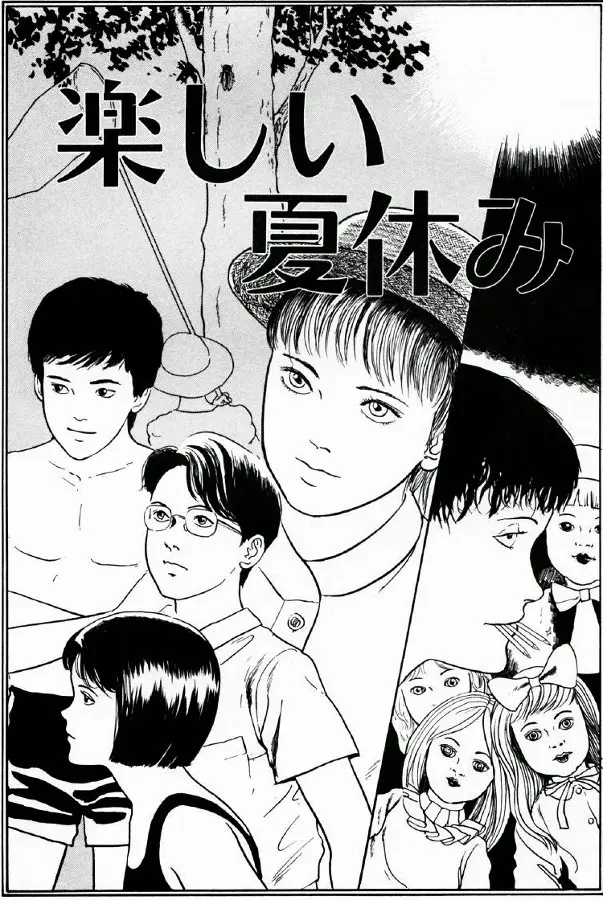
Fun Summer Vacation tells the story of a family with an evil younger son. That son is none other than Junji Ito favourite, Souichi.


On nights like this, I go out onto the streets, and suck blood out from women’s jugular veins.

Souichi displaying some of his madness to Michina

Fun Summer Vacation — Synopsis

Yuusuke and Michina have travelled on the train to see some relatives of theirs. These relatives are six people who live in the same home. The Mother; Father; Grandfather; two sons and the daughter. Most of the family are very warm and welcoming to the visiting brother and sister. However, they soon get to meet their reclusive, and ever-so-slightly evil, younger son — Souichi.

The very first thing that we see of Souichi, is him spitting a small metal nail at the visitors. This is as they try to take him some food up to his room. You see, by this time they had yet to meet him and so they are trying to say hello to him. Souichi’s first response is to be hostile towards them.

As their family holiday passes each day, Souichi displays more strange behaviours — sinister laughs; curses on the family; attacks with deadly nails. With his hostility specifically targeted towards his visiting cousins. But how far will Souichi go to make his presence known to them, despite being so introverted?

Introduction to Souichi

When I had previously thought about Souichi, I had only remembered him from the manga “Souichi’s Selfish Curse”. I think that is the most popular Souichi story, possibly due to it being an early episode in the Junji Ito Anime Collection. But I was surprised, and happy, to learn that there are in fact a whole bunch of manga stories involving the evil-doing, twisted young boy.

What is perhaps interesting too, is that he isn’t really the central character of this particular manga — Fun Summer Vacation. He is just the strange young son who seems to haunt his family from the shadows. Driven by some strange internal need to punish and hurt those around him.

He is seen skulking about in his room, sucking on old nails and trying to curse people with his doll replicas of them. He isn’t the most likeable of Junji Ito’s characters but I would be lying if I said that I didn’t have a small piece of my heart set aside for this boy-terror.

Does he just need some love?

His actions towards Michina, although twisted and selfish, opened up a crack in his evil facade for me. I couldn’t help but feel that he was trying to curse her simply to get her to stay back at the family home with him. That way they could remain together, while the others went out to the swimming pool again. Maybe he was lonely after all and felt that he could only really connect with her. Perhaps he was even in love with Michina in some twisted sort of way?

Despite his appearance of hostility, maybe Souichi is just a little boy lost? His mother seems to enable some of his behaviour by taking his meals to his room, and allowing him to stay locked away. His father doesn’t really seem to do much by the way of discipline either. And his older brother seems to just wish that Souichi was something that he isn’t. Perhaps if the parents had set similar boundaries and punishments as they presumably had for the eldest two siblings, maybe he wouldn’t be acting out in this way?

Or maybe Souichi is just a little evil-incarnate brat who simply loves to see people in pain. Whatever it is that drives him, I can’t help but feel that there is more below his diabolical surface than meets the eye.

In Conclusion

I really want to say that I loved this story, but in all honesty it isn’t too high on my list of favourites. Now don’t get me wrong, this is still a good manga to read – especially as it is the first appearance (I believe) of the now-famous character of Souichi. However, I can’t recommend it over more memorable stories such as Flesh Colored Horror or Army of One.

But despite the story not being one that particular drew me in too much, Souichi is definitely a favourite character of mine. Even if I’ve only seen him in three stories (including this one) at the time of writing this post. I trust Junji Ito enough to believe that he can take Souichi into some pretty dark and even comedic places before reaching the end of the crazy boy’s story.

I’m looking forward to further exploring the world of Souichi, his curses, and just how those around him manage to survive.

Anything but a Ghost

Anything but a Ghost tells the story of a woman who is discovered by the side of a mountain road covered in blood. But when that woman revisits the one who found her, she reveals that not everything is as it seems with her.


She died giving birth to me. When I came out, she was already a ghost. But she still cared about me. Even after that, she would come to breastfeed me.

Misaki tells Shigeru about her twisted past.

Anything but a Ghost — synopsis

Whilst driving through a mountain area, Shigeru finds a woman stood at the roadside with her back to the road. On leaving his car and walking up to her, he sees that she seems completely stunned whilst being covered in blood. Without hesitation, he drives her to the nearest hospital to get her checked out. As it turns out, the blood is not hers and she isn’t even injured in the slightest.

After some time has past, Shigeru and his wife are going about their lives — they even have a child on the way. Then out of nowhere there is a knock at the door. On opening it, Shigeru sees a beautiful young woman standing there, but fails to recognise her straight away. She introduces herself as the woman he helped by the roadside that day, and tells him her name is Misaki.

But it seems that she is to have a negative impact on his life. Her and Shigeru begin seeing each other in secret and soon reveals a strange, twisted secret about herself — one that he simply doesn’t believe. However, as the closing pages of this manga reveal themselves, not only does her secret show itself to be true, but things also get a whole lot stranger and a lot more darker.

A twist on the ghost story

Anything but a Ghost is a ghost story where the ghosts are not the ones to be feared. Misaki is a young woman who seems to be somewhere between that of a ghost and that of a human. And even though she is drawn as a very innocent and delicate looking woman, she always has an air of creepiness to her. This is helped largely due to how she is introduced to us. We know something is not quite right — we just don’t know what it is at this point.

When she mentions that she can see Shigeru’s ghosts following him, I immediately thought of them as malevolent things. I was sure these ghosts she talked about would be grotesque monsters that live in the next plain of existence, just waiting to come through. But the truth is far more sinister than that.

I always enjoy how Junji Ito seems to be able to take our preconceived ideas of what typical sorts of horror stories are, and turns them on their head.

Misaki shows her true self

Strange food cravings

In horror fiction, I think we are used to seeing monsters that prey upon the weak before eating them. Whether that be vampires, werewolves, other-worldly beasts or even cannibals. But this is the first time, as is a lot of the times reading Junji Ito’s work, that I have seen the idea of eating one’s victims in quite this way.

The very idea of having a person who feeds on ghosts is an incredibly inventive one and, dare I say it, genius in it’s own way. But it doesn’t just end there. I absolutely loved how, when Misaki would bite down into her ethereal feast, somehow blood would spill out and cover her face. It’s almost like she is able to pull the ghosts of those who have passed, into our world, if only for a moment — for one last taste of pain and suffering. As if death wasn’t enough.

And without giving too much away, the visions that Junji Ito was able to put into my mind, purely by suggestion, were pretty horrific. When she bites into what she eats towards the end, I could see every single blood-curdling inch of it, yet Ito drew none of it. He is truly a master of not only his own imagination, but of toying with his readers’ imaginations too.

In Conclusion

This is an excellent stand-alone story from Junji Ito that is as unsettling as it is inventive. What was perhaps most noteworthy for me, was how it is completely grotesque — especially with what she eats towards the end — but without you actually seeing the action itself. Kind of like how Quentin Tarantino was able to gross out early 90’s audiences with his famous ear-cutting scene in Reservoir Dogs. Despite never even seeing the cut.

You never actually see her biting into any pound of flesh. But the result is no less effective. If anything it’s perhaps more so.

I would highly recommend this as a first read from Junji Ito’s catalogue of work. It is readable out in public without attracting people’s concerned stares, with no real displays of gore and flesh. However, it will perhaps leave you feeling like you have seen as much.

Anything But A Ghost is anything but a standard ghost story.

You can read Anything but a Ghost here. (Please support Junji Ito by buying his manga in your own language where available)

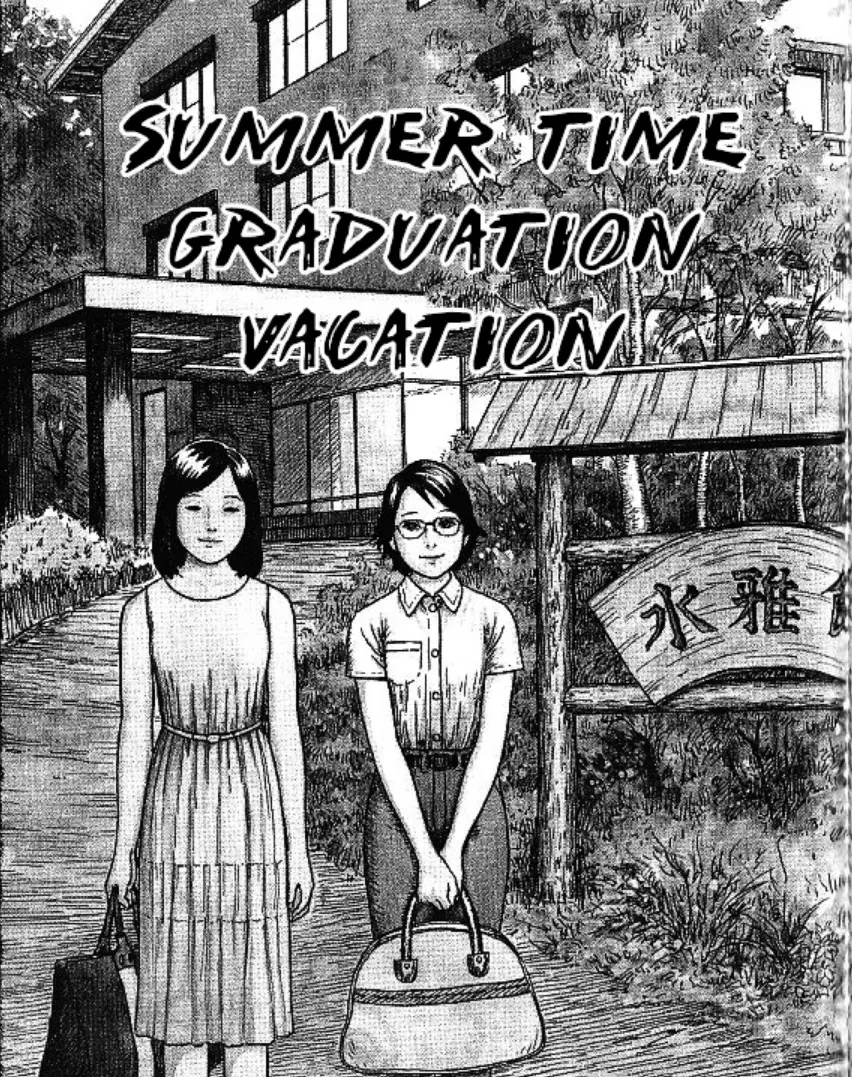
Summer time graduation trip

In Summer time graduation trip, an eerie bathhouse beneath a picturesque inn hides a mysterious secret.


Not a single person speaking… And during the whole time we were there, not a single person got up…

Hezi describes her experience in the bath house

Summer time graduation trip — synopsis

A woman recalls her time after her graduation thirty years ago. During that time, she and a friend took a trip to a holiday inn towards the north-west of the country. The place was relaxing and surrounded by beautiful scenery. However, hidden beneath the inn was a bath house with an eerie secret.

On arriving at the inn, the pair decide to investigate the local facilities — first on their list was the bathhouse. As they descend the steps towards the bathhouse below, they notice how the stairwell seems to take far longer than it should do to get down. In fact, the further they go down, the darker the bottom seems. Then as they look back up the way they came, nothing but darkness there too.

Before long, they pass a strange woman who is walking towards them up the steps. This woman is lit only by a small lantern she is carrying. She nods to them that they are heading in the correct direction to the bathhouse. Then as if by magic, they are at the foot of the steps, feeling the steam from the bath behind the door.

The main character then takes off her glasses before entering the large bath, severely limiting her vision. It is one of those large public steam baths. Sat in the water, she can make out shapes of people close to her, but can make out none of their facial features. She just sees shapes and shadows in the steamy water around her.

Suddenly, her friend Hezi taps her on the shoulder and urges her out of the water and to leave with her immediately. But what did Hezi, with her much more attuned eyesight, see in the bath’s waters? What was it that the main character could not see? And just who was that mysterious figure in the stairwell?

Hezi and her friend arrive at the inn

Almost a ghost story

At first read, I couldn’t really think of how to approach writing about Summer time graduation trip. You see, it kind of ends just as it seems to begin. We get introduced to the location of the inn, then we see the mysterious lady who passes them in the hall. Following that we get the reveal of the strange people in the bath, all with their heads facing away from the girls. And then just as the inn worker seems to be about to reveal a clue to move the story along, it ends.

After reading some comments by others, I was introduced to the idea that this could actually be a troll ghost story. In fact, it’s a ghost story where the characters actually make smart decisions and get out before anything bad happens to them. If the story had taken a normal route, then perhaps the maid would have revealed a history of the building and the origins of the lady on the stairs. This would probably have led to some investigation, followed by some trouble with ghosts.

But what’s almost funny is, is the girl just stops the maid in her tracks and screams “Never mind, Ma’am! […] If we continued to listen to her, it might turn out to be really scary, right?”. In fact, the more I think about this story, the more I’m convinced that it is in fact a comedy. But it’s only a comedy in the punchline, like a dry-witted comedian who you didn’t realise was telling a joke until you find youself laughing at the end.

The steps seem to go on forever

Lost potential?

Although I respect Junji Ito for taking a chance on the story in how he ended it, I cant help but want more of the story revealed. If only the girls had taken the other route, and pursued a line of enquiry that would have inevitably meant risking their lives and possibly their sanity.

I loved the imagery of the bath house full of people too, all with their backs to the girls. We are left to wonder whether they are perhaps disfigured or dead… or both. Maybe it’s like a nightmare where if they are turned around they would reveal nothing more than the backs of their heads once again.

And that lady on the stairs too. She seemed like an interesting chaarcter, carrying her small lantern and apparently disappearing up the steps behind them. What was her purpose? Was she some kind of overseer of the dead below? Was she evil? Good? Or maybe an impartial lost spirit just searching for rest?

Maybe it was all some lost potential for a longer tale? Or maybe it was further strokes of genius from Junji Ito, in letting us imagine for ourselves just what was happening at that inn.

The bath full of mysterious people

In Conclusion

Summer time graduation trip is one of Junji Ito’s manga stories that has had to take time to grow on me. I don’t think I really “got it” on first reading. I may have even thought I didn’t have the complete version — I don’t remember. But it has grown on me and even makes me smile when I think about the ending to this one.

It’s a risky choice to write a ghost story but then end it before any meaty ghost encounters occur, but if there’s one thing I’ve come to expect from the master is that he isn’t afraid to take some chances. If you want gory or ghosts, or people with seemingly doomed fates, then you can find those aplenty amongst his other works.

However, with Summer time graduation trip what you are getting is, as I believe, a tongue-in-cheek ghost story. I can even picture Ito watching your reaction as you approach the end, just to see if you get it. I mean, I could be completely way off, but these are just my opinions. Let me know in the comments if you have any other takes on this one.

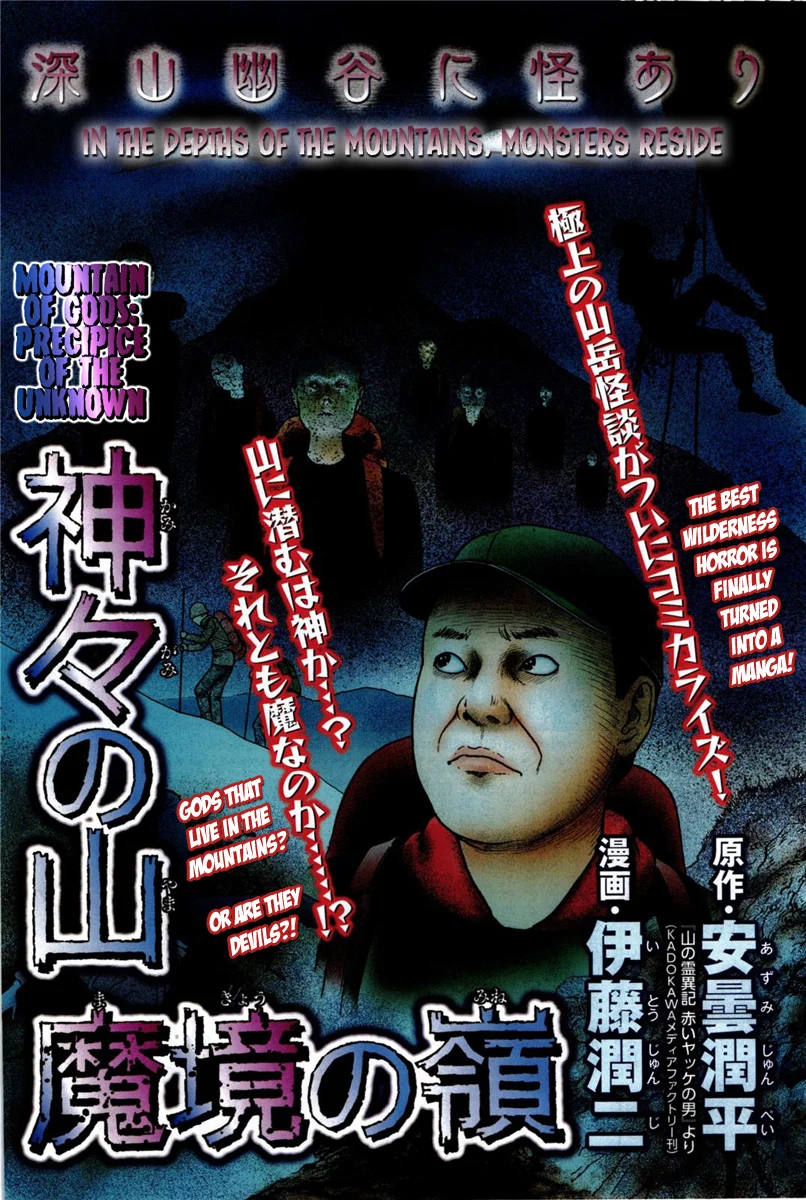
Mountain of Gods: Precipice of the Unknown

Mountain of Gods is one of the chapters in an anthology of manga stories about mountain demons called Yama Kaidan. Yama Kaidan roughly translates to “Mountain Stairs”.


That man wasn’t smiling. He was sneering at me with immense hatred.

Ishida describes his encounter with The Sneering Man

Mountain of Gods — Synopsis

This story tells of three hikers who are comparing their past hikes with one another. However, the story soon veers into the spooky as the subject of a recently-missing woman hiker comes into the conversation. All that they know is that she went out hiking from the same cabin they now sit in, happy as can be – according to the cabin manager, but who was discovered dead at the foot of a snowy drop.

This brings to mind eerie encounters that each of them has had on their past hikes, which they each describe in turn. One tells of becoming alone on a mountain-top path before seeing a very thin, sneering man coming towards him at an unnatural pace. Another tells of a similar face pressing its way through his tent, Freddy Krueger style.

But will the mystery of this sneering man (is it even a man?) or the death of the lady hiker ever be solved?

Ghost stories

I think that this story is supposed to do what nearly all ghost stories do. It tells of an unnatural occurrence with some malevolent force, but never gives any explanation of it. This is told purely from the perspective of the hikers in the cabin and their own memories and imaginations on what they think could have happened. We are left to wonder whether there even is such a person as the sneering man, or whether it is a common hallucination from being up so high in the altitude.

It felt almost light in content when I first read it, partially due to the static nature of the main characters. But as I re-read it multiple times, the grimacing face of the sneering man began to grow on me. And once I learned it was actually part of a larger anthology from multiple artists, it all came together. Although I do enjoy this for what it is, a short ghost story about a hiking urban legend, I believe that it would sit much better when read along with the other stories in its collection.

Ishida tells of his past hiking experiences

I haven’t been able to find any of the other chapters from the Yama Kaidan anthology. All I know is that it is a collection of mountain-related ghost stories about gods or demons that could live in the mountains. If you find any of the other chapters, please do let me know in the comments below. Thank You. 🙂

The Sneering Man

The Sneering man, like Fuchi from Fashion Model, is a character that I would love to see much more of. It’s almost teasing that we get the short glimpses of this person in Mountain of Gods.

Despite this being a lesser-known Junji Ito work, I think it is one of the best examples I’ve seen of him slowly revealing horror on the page. If you look at the first glimpses of the sneering man, and the switching between it and Ishida as they get closer, the way in which the true nature of the strange figure is revealed is incredible. The way that the smile reveals slight arching in the corners of the mouth as it comes into focus. The darkening of the facial features as the distance between them shortens. Then that horrific grimacing full-page face that almost scares you out of your seat.

A big part of me is always glad when a menacing figure such as this remains mysterious. There’s nothing worse than having everything explained to you when your own imagination can be so much scarier at times. But there is a small part of me that would kind of like to know where this sneering man came from.

In Conclusion

Mountain of Gods: Precipice of the Unknown is a great short story to give you the creeps before bed time. The character of the Sneering man will surely stick with you after reading — I think that face is almost etched on the back of my eyelids. 😀

Due to it’s minimal graphic horror, I think this would be perhaps a good introduction to Junji Ito’s work, for those who haven’t read his stuff before. I mean, it in no way represents the crazy imagination that you will find in say, Uzumaki or Tomie. But if you are looking to tread lightly into Ito’s world, this could be a good choice for you.

I’ve only been able to find this story in a translated version for my own language on Manga Rock. But please always support Junji Ito where you can by buying his official works.

Be careful when you go out walking…

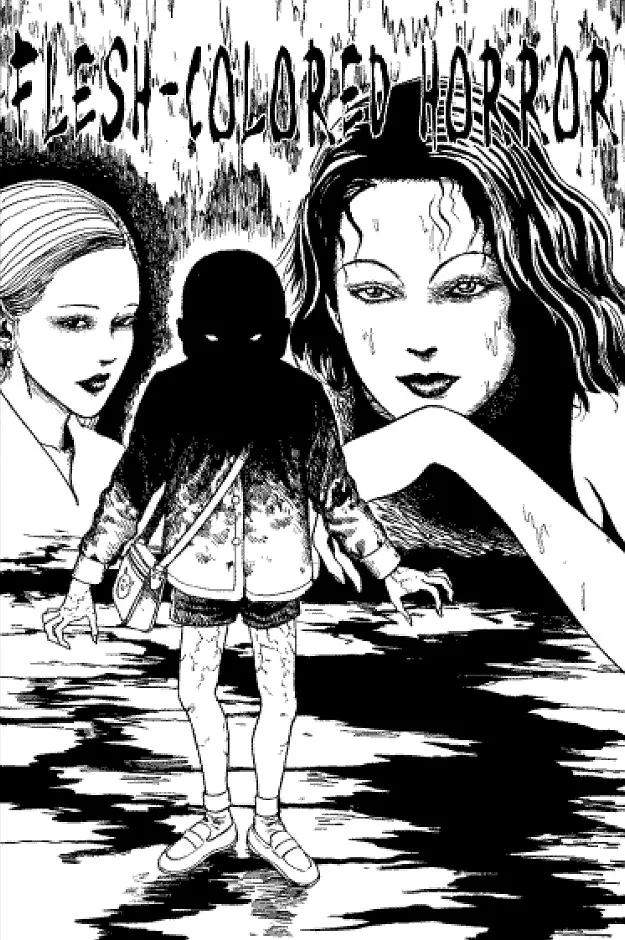
Flesh Colored Horror

Flesh Colored Horror focuses on the suffering of a young boy at the hands of his twisted and skin-obsessed mother.


I’m not tearing. This is the peeling…

Chikara as he destroys other childrens’ artwork.

Flesh Colored Horror — Synopsis

Momoko Takigawa is a school teacher who teaches young children at the Hikariyama Kindergarten school. Her students are all regular, everyday children… except for one — Chikara.

Chikara is a scary-looking child, whose veins trace dark lines over his bald head. His eyes are blank white and piercing, and his mental state is violent and unstable. Chikara often lashes out at his fellow students and is unable to form any sort of positive bonds with them.

After a bloody incident involving Chikara and another student, Kosuke, he is expelled from the school and instructed to never return. However, one day he follows his old teacher Takigawa home from the school, and she agrees to take him inside before escorting him back to his own home.

But when the teacher starts to become more involved in the boy’s life and in his well-being, a horrifying and violent secret is revealed about the boy’s family. We learn of his mother’s obsession with beauty. And we learn the lengths she’s willing to go, in order to give her son that beauty. All with no care as to the cost of his mental or physical well-being.

But what lengths will his mother go to, to finish what she has started? And how much can her son endure before he finally snaps?

A tortured young boy

The subject of a child’s abuse is always a delicate one to approach in fiction — and rightly so. Junji Ito has dealt with these before with stories like The Bully and the Tomie chapter Boy. But in Flesh-colored horror, the pain that Chikara endures is on a whole new level from those — at least in my opinion.

I felt that Ito approached this subject very tastefully. He seemed to keep it grounded but still within his story’s crazy boundaries. My initial feelings towards Chikara were those of disgust — the desired effect, no doubt. But by the end I was fully on his side after having learnt his story. And not only that, but it even taught me something about not judging people too quickly.

Chikara doesn’t know how to make friends in the playground

Although the tearing of the school paintings was a spiteful act, it was only what Chikara had picked up from home. We see his mother’s obsession causing her to peel away their home’s wallpaper — a metaphor for the peeling away of skin to what lies beneath.

And when Chikara attacked Kosuke and caused his face to bleed all over, it was a dreadful thing to do. But again, although I don’t condone it, this too was a learned behaviour from his mother. From all of the peelings away of skin she has forced him through.

This is normal life for Chikara, and it truly is a shame — both for him and those around him.

Skin deep

There is a saying that goes “Beauty is only skin deep”, which means that a person’s character is more important than how they look. This saying is no more apt than in Flesh Colored Horror — albeit in a slightly tongue-in-cheek way. I loved the insane idea of going to the extremes of trying to preserve one’s beauty by removing the skin and bathing it in saline solution. Then admiring the muscles and tendons beneath as a thing of beauty. Ito definitely has a way of creating these fresh and crazy characters with very unique quirks. And he often does so by taking very normal behaviours, like using skin cream to maintain one’s complexion, and turning it up to crazy.

Chikara’s Mother always seems to have just gotten out of the bath

I also enjoyed the exploration of the mother’s obsession with her beauty — an obsession which ultimately leads to her undoing. I believe that the loss of her husband in the way that he went, directly led to her strange form of body dysmorphia. It was just a shame that her twisted notions of beauty were then forced upon her child.

But what I found most interesting in this story, was how we initially see Chikara. We see him as violent and almost-grotesque looking. But later we learn how both his appearance and his actions are a direct result of his terrible upbringing.

And on the flip side of that, we see his mother and his auntie — both beautiful women, who initially come across as friendly — who are later revealed to be the most despicable characters in the manga.

Beauty is only skin deep.

I’m glad that Chikara got to have some kind of revenge on his mother. Burning away his mother’s skin before tearing her exposed tendons with his bare hands was a hell of a way to go. But strangely enough, it felt like the logical result of what the boy had to endure. She created this viscous animal within her child, and now that very same animal is being unleashed on its creator. It is so crazy and so unbelievable, but it is so very enjoyable to read too, and definitely very Ito-esque.

In Conclusion

Flesh Colored Horror blew me away when I first read it, I wont lie. The serious tones of a child in danger drew me into the story — I knew it was going to be a thought-provoking and heavy piece. But it was it’s crazy ending and visceral imagery that moved this manga up into my top ten.

This isn’t one for the casual manga reader, I don’t think. If you like your horror to be dark and visceral, then great. But if you prefer easy jump scares and a minimal amount of flesh and blood, then tread carefully; I don’t think this is for the feint-hearted.

Any fan of Junji Ito’s who hasn’t read Flesh Colored Horror yet will get a real kick out of this one. And if you do enjoy it, you are sure to end up reading it multiple times.

p.s. Bonus Points to Ito for reminding me of Hellraiser 2 with this one. The image of the woman’s skin being pulled off like an all-in-one body suit immediately made me think of Julia’s demise from that film. 🙂

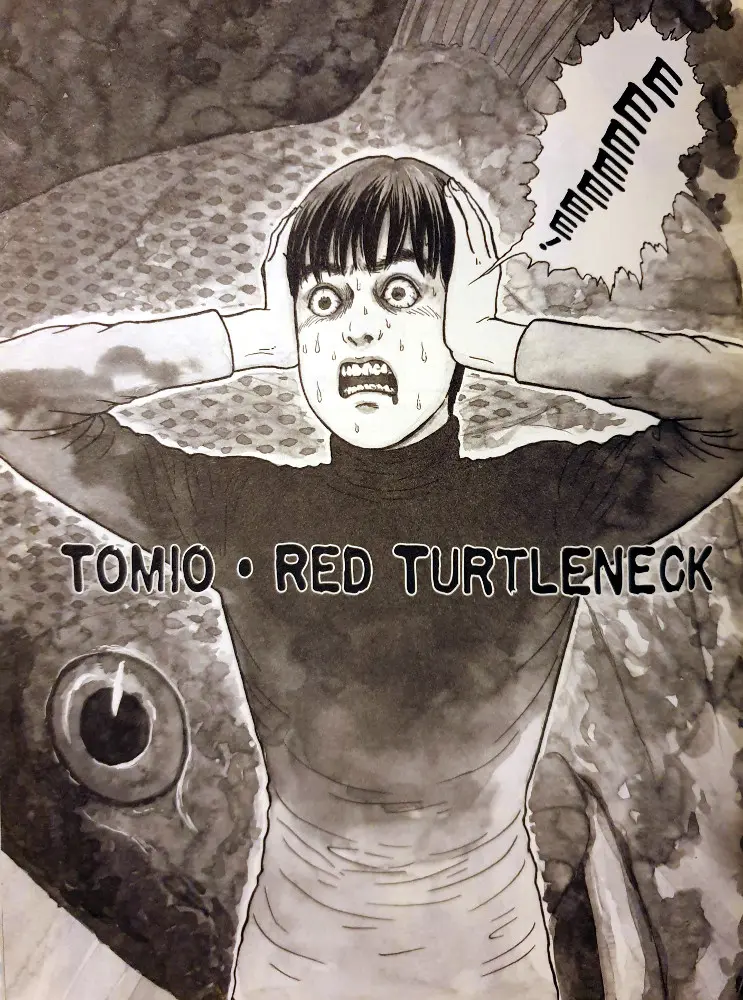
Tomio Red Turtleneck

In Tomio Red Turtleneck, a young man cheats on his girlfriend and almost loses his head.

Tomio Red Turtleneck — synopsis

Tomio Red Turtleneck is one of the more nightmarish short horror manga stories from Junji Ito, as well as being one of my favourites. Taken from his excellent Fragments of Horror collection, it tells the story of a young man dealing with a very strange injury.

We join Tomio’s story as he is walking down a street, grasping at both sides of his head, looking very distressed. His eyes are fixed and his teeth are gritted together as he makes his way to his girlfriend Madoka’s home. On arrival he pleads for her help, but it seems as though he’s been a bad boyfriend. She tells him simply to just “go back to that woman”.

Flashing back to some days earlier in this couples life, it is revealed that Tomio did in fact begin having an affair with a fortune teller. This same teller foresaw their relationship as being “doomed”. But this seems to have been a fortune reading designed for one thing — to get Tomio into bed with said teller.

And it worked.

However, after they had made love, the fortune teller reveals her true evil intentions towards Tomio. He has no choice but to run from her, but not before she manages to curse him.

But just what happened when Tomio and the fortune teller met up? What evil secrets does this cursed woman hold and why did she target Tomio? And just what has she done to cause him to go running back to Madoka with his head clutched between his hands?

Strong Women

Ito has a talent for bringing strong women to the forefront of his stories, perhaps none more so than Tomie — the immortal, self-replicating demon girl who drives men to go crazy over her. However, Tomio Red Turtleneck displays two very strong women too.

The first is the fortune teller, who manages to captivate Tomio into having an affair without any real effort on her part. Perhaps it was magic but nonetheless she had that power over him. She is an imposing figure over the story and is definitely someone not to be messed with.

The Fortune Teller reveals her true intentions

The second is Madoka. Despite being cheated on by her boyfriend, Madoka isn’t saddened or feeling sorry about the situation. Instead she kicks him out in anger and is even the one to save his skin towards the end. It’s unsure whether she will remain with him after this is all resolved, but one thing is for sure — she sure knows how to handle herself and wont go down without a fight.

Monogamy

If ever there could be a horror manga allegory for not cheating on your partner, then Tomio Red Turtleneck is it. Tomio doesn’t come across as a particularly nice person in the opening pages. He screams at his girlfriend Madoka that the fortune teller is “way hotter” than her, before running off to her bed. I personally couldn’t wait for him to get his just desserts.

I found that the fortune teller and the affair with her was a great metaphor for, and even a warning against, being unfaithful to your partner. Tomio sees the teller and is taken with how beautiful she is. He ends up in her bed as he probably believes himself to be “upgrading” his lover in his mind. But of course, once he discovers her true intentions, and the severed heads of other men whom I could only assume cheated on their partners too, he realises he has messed up.

I don’t for one second think that what he ends up going through can reconcile how he treated Madoka, but perhaps having his head almost removed is a little bit too far a punishment. Perhaps.

Children of the flames

I loved the imagery of the three children that were revealed once the fortune teller had been stabbed. Were these malicious spirits that were in control of an otherwise innocent fortune teller? Or were they in fact unborn children of hers who’s presence was still felt by those around?

I couldn’t help but feel sorry for Madoka and Tomio too. Yes, even Tomio. I think that the fortune teller had some kind of control over him. Whilst I don’t excuse his actions, or his attitude towards Madoka, I did feel that he was a very naive person — almost child like. And while Madoka came across as more head strong, she too felt not much older than a child.

The fortune teller on the other hand seemed much older and infinitely more in control of her self. Although her motives were never revealed, she definitely had control over the situation. Of course, she did underestimate Madoka at the end. So I guess she couldn’t have been that much in control.

In Conclusion

Tomio Red Turtleneck is a quintessential Junji Ito manga that I think you should definitely read. Whilst it’s not in my top 5, it is definitely up there towards the top of my favourites. The imagery of Tomio stumbling down the street clutching at his almost-severed head is one of those Ito images that I just won’t ever forget.

Junji Ito has created such iconic imagery through his career so far, and no-doubt will continue to do so. But I think that Tomio and his red turtleneck are, at least for me, one of the most memorable.

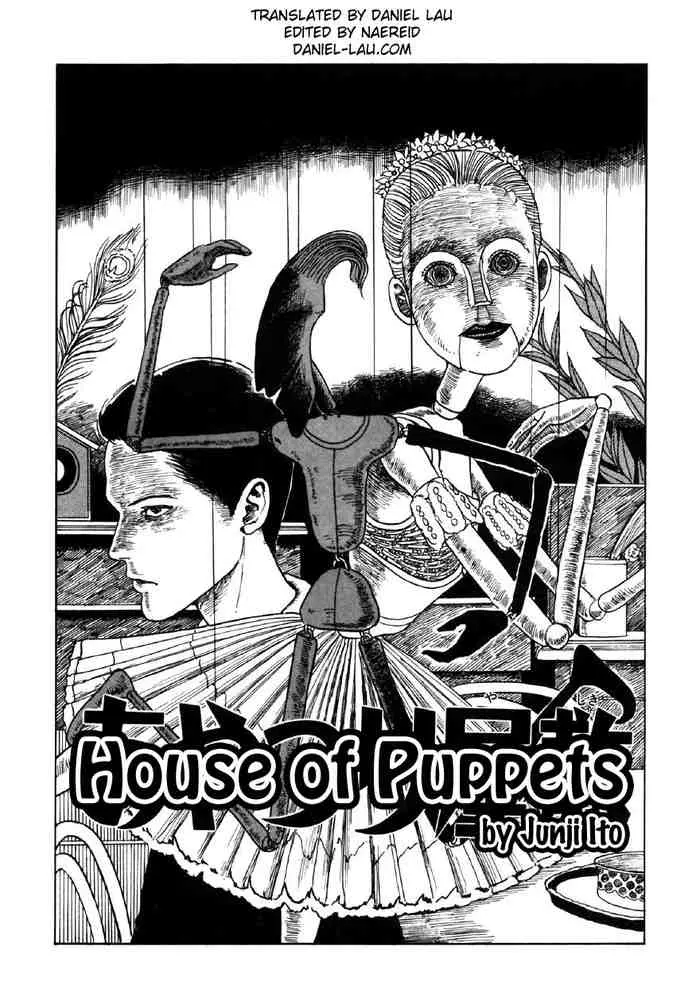
Marionette Mansion

Family reuinions and creepy puppets. Junji Ito delivers a strange and enjoyable story with Marionette Mansion.


That’s right. Just let yourself go limp. Turn yourself over to the puppeteers.

Yukihiko enticing his siblings to his way of life.

Marionette Mansion — synopsis

In Marionette Mansion we follow Haruhiko — a boy from a travelling entertainment family. Him and his family move from town to town putting on their puppet shows for the townspeople. Because of this, Haruhiko is unable to settle down and make any lasting friendships.

Whilst staying in one particular town, he befriends a girl before having to move on again. Whilst they have their short time together, he shows her his family’s travelling home and the puppets that they work with. One puppet in particular creeps the girl out, causing her to knock it to the floor out of shock. This puppet’s name is Jean Pierre — more on him later.

Years later, after his older brother had left and the father had passed away, Haruhiko and his young sister Natsumi are living a simple life together. No more travelling from town to town. Everything is fine, when all of a sudden he bumps into the girl he had befriended all those years earlier. With them now both adults and seemingly settled in their lives, they start to grow closer. But this is a Junji Ito story, and you know that their story doesn’t just end there.

Kinuko and Haruhiko renew their friendship

Haruhiko discovers that the brother who had left the family years earlier, has in fact been living close by for some time and urges him and the young sister to visit.

They accept their older brother’s offer.

To Haruhiko’s and Natsumi’s surprise, the door is answered by none other than Jean Pierre. Yes that’s right — Jean Pierre the puppet. They discover how the older brother and his new family live the lives of puppets on strings — quite literally. They seem to be getting controlled by some unseen entities in the ceiling above, the strings being lowered through a system of grids.

But how will Haruhiko adjust to not only getting back in touch with his brother, but also getting used to their very unconventional way of living? And how is he going to keep his little sister safe from the danger that is sure to be near?

Who’s pulling the strings?

This is without a doubt one of the weirdest stories of Junji Ito’s that I’ve read for a while. It raises the question “Who is pulling the strings”. Of course, the family at the start literally pull the strings of the puppets in their travelling show. But in the later years of the siblings’ lives, that role is reversed.

The fact that Jean Pierre – a seemingly inanimate puppet – welcomes them at the door, let me know that this was going to be an odd one. I realise that Junji Ito is known for how strange and infinitely imaginative his mangas tend to be. But in Marionette Mansion there seems to be a sense of whimsy to the whole thing. Like he is simply having fun playing with these characters and literally pulling their strings for his own, and by extension our, enjoyment.

After reading this in the Shiver Collection, I also read the accompanying backstory of the manga that comes with each chapter. In it, Junji Ito says:

…I’d like to hang my upper body from the ceiling. How lovely would it be to leave my body like that and get the work done? This story came from thoughts like these…

Junji Ito talking about the origin of the story for Marionette Mansion

Interpretations

Despite Ito’s explanation of the story’s genesis, I still can’t help but try to find extra meanings. I thought that the “family on strings” was an interesting metaphor for not being in control of one’s own life. From the start the siblings had no choice but to travel with the family and their puppet shows. Then later the older brother, although the first to leave the family, still relys on his strings being pulled for him.

The Wooden Ballerinas

The welcoming of Haruhiko and Natsumi into the house presented a danger to their way of life. This danger is especially true for Natsumi, who is still very much young and impressionable. Although Haruhiko comes across as being very headstrong and wishing to be in control of his life, Natsumi perhaps wont see the long-term effects of having one’s decisions and movements made for her.

I think of Marionette Mansion as a tale about fighting the urge to have everything in life done for you. To fight against handing over responsibilities to others for the sake of living an “easy” life. And to always strive to be your own person — not imitating or relying on others for your own sense of self.

In Summary

This is an enjoyable story that came across as a lighter read than other mangas in Ito’s large body of work. Nothing in this story made me want to look away in disgust. However, there are still some nice gruesome moments to keep your pallet salivated.

I loved how the main character fought his side of the argument and does his utmost to protect himself and Natsumi, no matter what pressures get placed on him. He is a great conduit for the lessons that I believe we can learn from this story:

Never be afraid to be yourself and always be willing to fight for your independence and dignity.

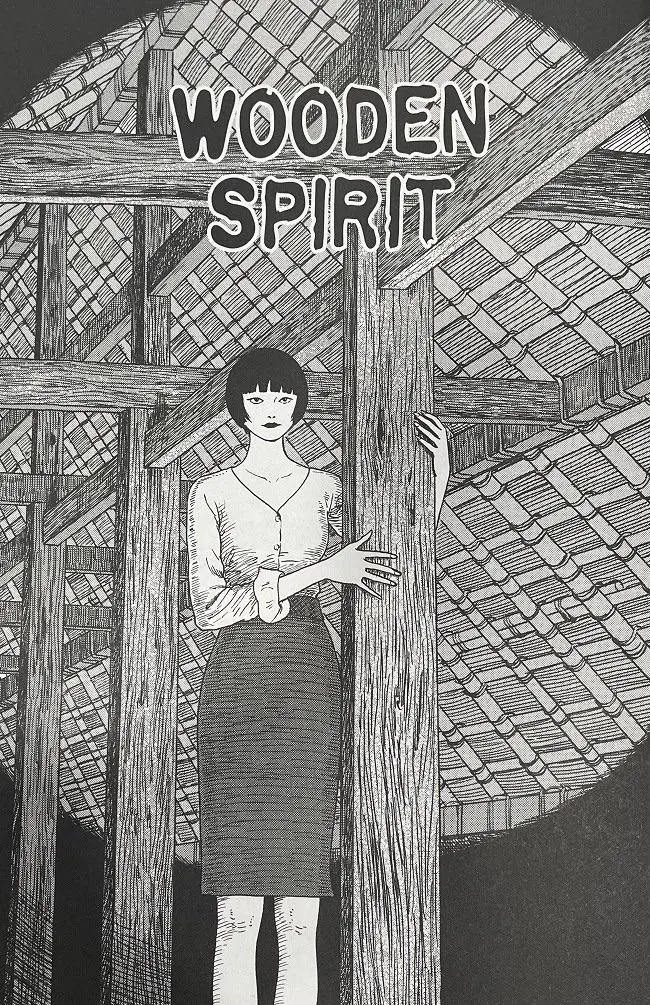
Wooden Spirit

In Wooden Spirit, Junji Ito takes us on a strange journey of love. Specifically, the love between one woman and a house that she finds desirable…

Wooden Spirit — Synopsis

In Wooden Spirit, we are introduced to Megumi and her father. They live together in an old wooden house that has recently gained cultural recognition. Despite them being the only ones who live there, the house has eleven rooms to its name. And they take very good care of each and every square inch.

In the story’s opening scene a woman knocks on their front door and asks to take a look inside the house. This woman, Manami Kino, immediately falls in love with this house. And when I say “falls in love with it”, I really mean it.

Before long, she and Megumi’s father become an item and she eventually moves in.

What is most strange here though, is Manami’s behaviour towards the house itself. This woman takes house proud to a whole new level. But just how far will she go with her strange antics?

One with the elements

This is a house that has been given cultural status for its historic importance. And then when this mysterious woman comes by she remarks at the elegance of the wood work. She sees the walls; the floors; the joists and remarks at how “sexy” they are.

At first read of this story last year I took it at face value. I saw it simply as a woman who makes her home within this house, before beginning to make love to it. I enjoyed the read for how ludicrous it was and thought nothing more of it at the time. However, on revisiting it with my new appreciation for Junji Ito, I am seeing deeper into the material.

One wild theory

Later on when she reveals herself for the demon she is — with an almost wood-like appearance — I came to an interesting thought. What if she was some kind of tree spirit? Yes, I know the story is called “Wooden Spirit”, but I thought I’d dig a bit deeper. What if her love for this house is not as a result of the building, but of the materials instead? Could her love towards the walls and the beams come from them being made from a former partner of hers when they were once both trees?

Megumi and her Father’s house

My theory does take a few leaps in imagination, but that is precisely one of the biggest things I enjoy about Ito’s work: the new connections he helps to form in my brain. Yes, this is a bit of a crazy theory, but is it so unbelievable within the world of Junji Ito? I don’t think so.

I loved how the story ended too. It felt almost poetic for me after I’d been on this theoretical journey in my mind. Let’s think for a moment how the wood has been taken from its natural place: the forest, and forced to become something fit for humans: a house. From this idea we could suppose that what this demon / spirit woman is doing in the end, is herself turning the wood back into something that she could then love again — flesh and blood.

In Conclusion

Wooden Spirit is one of Junji Ito’s strangest stories when taken at face value, as I once did. But when I began asking myself questions about its world, I managed to build up that world even more in my mind’s eye.

Whether Ito had any similar thoughts behind this story as the ones I have discussed here, I’ll probably never know. But what I do know is, is that no matter what physical images someone sees on this story’s pages, his stories have the power to create unique and interesting visions in the minds of those readers… if you’ll let them.

As the second story in his Fragments of Horror collection, Wooden Spirit will open you up to new experiences within Ito’s work. To a very unorthodox and, dare I say it, beautiful love.

Love As Scripted

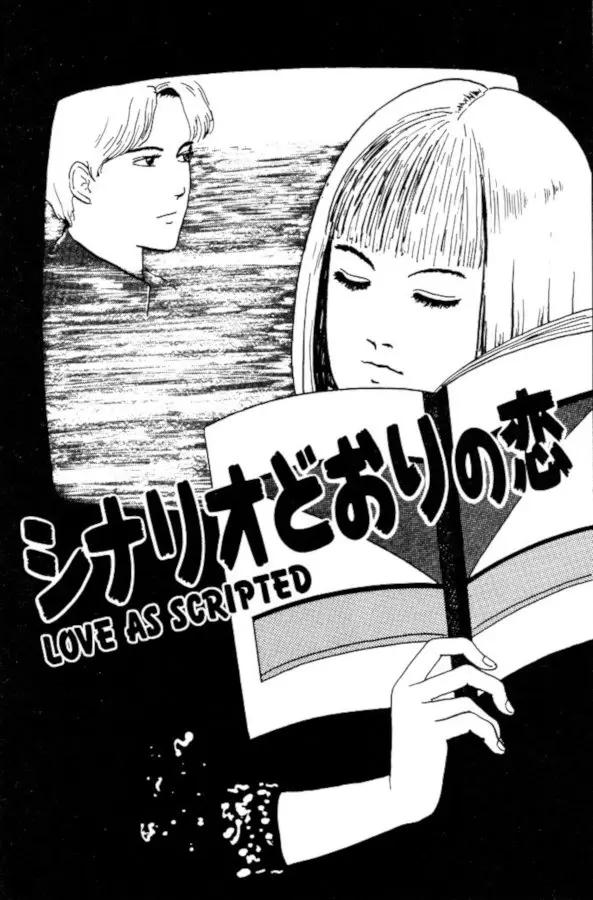
In Love as Scripted, Junji Ito explores a very strange relationship between a young woman and a would-be Casanova.


I started to see past the script and its limitations, and I began imagining I was chatting with him for real.

Kaori watches the video that Takahashi made for her

Love as scripted — Synopsis

We join the story in the throws of an argument between a couple. Their names are Kaori and Takahashi. Kaori is very upset due to her boyfriend (Takahashi) telling her that he’s leaving her. In the heat of the row, Takahashi does something very unusual — he gives Kaori a video tape of himself to play whenever she misses him. The way that Ito draws him, makes me think that there is no evil intent in his actions; he seems sincere in his gift.

But Kaori, after having apparently been warned about him before, lashes out with a large kitchen knife. Then just as that knife is coming down towards him, we flashback to some time before they were together.

We go back to when Kaori was a new recruit in her theatre troupe and the screenwriter for that group was none other than Takahashi. When we see the beginnings of a romance start to blossom, she is warned off him by a friend in the group. But love is blind it seems, as she moves forward into her new relationship without regret.

We soon catch back up to the present day, where the results of her violent actions are revealed. But instead of worrying about needing to dispose of Takahashi’s body, she instead decides to play the video tape that he had gifted her. What this video contains is something very odd indeed, and may even be the reason why she could possibly fall in love with him all over again…

Video killed the…

This was an enjoyable read with little to no real body horror within, save for a single stabbing. Instead, Love As Scripted is more of a psychological look at love and what it possibly means to love someone.

Despite her actions, I found myself feeling sorry for Kaori — indeed all girls that Takahashi had presumably dumped in a similar way. I mean, technically there is no crime against dumping girls one after the other, but the way in which he does so can definitely be thought of as malicious.

And that is the key thing I wanted to explore here — the interpretation. Although I don’t condone how he seemed to mess these girls about, I couldn’t help but dig a little deeper into some of his possible motivations.

Kaori does a terrible thing

Man with a camera

Here we have a man who never really comes across as malicious in how he treats these ladies, at least not when he’s with them. Instead he seems to almost fall in love with each one in turn. Then the fact that he writes and records hours and hours of what is essentially a personal monologue, along with spaces for the video recipients to converse with the recording, makes me think that he is sincere with that gift. The way that Ito draws him also seems to support that theory.

Odd, yes. But sincere.

Maybe Takahashi suffers from a crippling inability to commit. Or perhaps he believes himself to be no good for these women? Maybe that’s why he goes to the trouble of making all of these recordings? Again, I’m not looking to condone any of his actions, I’m just trying to look at those actions from fresh angles.

But then he could always just be a complete bastard with zero regard for others’ feelings.

A predictable love

The real sadness in Love as Scripted, at least for me, was the conclusion of Kaori’s story. It’s a shame how her love, and anger, for Takahashi drove her to stab him. She pretty much seals her future with that fateful blow. It is also a shame how she realises just how much she loves him through the medium of the video that set the attack off.

Kaori isnt impressed with Takahashis video

But that video will never be self-aware. It will always be exactly the same tomorrow as it is today. It will never offer anything new by means of conversation and will never surprise her. But she seems content in this predictable love.

What I found perhaps most sad with her was that even when she realised what she had done, and is then offered a chance to save him, she just passes it up. She knows that her new Takahashi will never leave her; will never cheat on her; and will never upset her.

But ultimately it will never be able to love her either.

In conclusion

Although this is one of Junji Ito’s shorter stories, I found Love As Scripted to have lots of charm. Despite it being a sad, more psychological piece than others, I found myself enjoying what I was looking for between the pages.

Perhaps I am looking too deep into it. Maybe Junji Ito just thought of a weird idea for a relationship and just ran with it? Perhaps he had no real intentions of exploring deeper themes. But I like to believe that he knew full well all of the themes he was exploring.

I think that this story could be enjoyed thoroughly as an introduction to Junji Ito as well. And while it gives no indication as to depths he goes to with his more graphic depictions of horror, it does give you an introduction to his work and his excellent story telling.

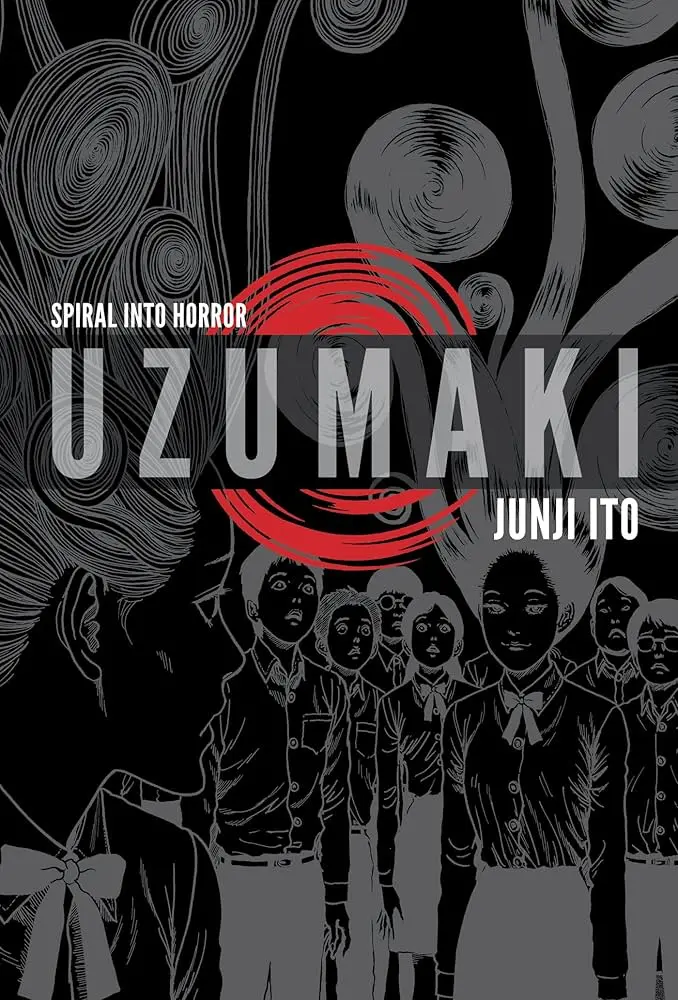
Uzumaki by Junji Ito

Often seen in nature, the spiral could represent mystery and infinity. But in this series it also represents horror and cursed flesh.

If you like horror manga, or are even just vaguely aware of it, chances are that you have heard of this manga title. Uzumaki is pretty much the quintessential horror manga series and is one of the titles to cement Junji Ito’s title as the master of the genre.

What is Uzumaki about?

The word Uzumaki itself is Japanese for spiral. From wikipedia:

“In mathematics, a spiral is a curve which emanates from a point, moving farther away as it revolves around the point.”

Wikipedia definition of a Spiral

And it is exactly this shape that is the core focus for the entirety of Junji Ito’s masterpiece. It starts off small, with one particular man’s interest in small shells and patterns he finds in nature. But, in true Ito style, the story quickly escalates into a terrifying journey into the depths of all spirals.

Slowly, over the course of twenty chapters, Junji Ito explores the spiral pattern in many different areas of life. All within a small coastal village in Japan and its residents. From schools to hospitals; from the young to the old; and from love through to terror and disgust.

An exploration in twenty parts

Over the course of the next few months, I will be exploring each of the chapters of Uzumaki in turn. I will be attempting to dig through the horrifying visions to find the meaning within the pages. To really dig deep and explore my own thoughts and feelings about this awesome series.

Much like the Tomie Series I wrote about, I feel that this series would do better as a series of posts, instead of just one huge post covering it all. There are just too many great parts and interesting characters to risk washing over any of them.

I invite you to join me

I would love for you to join me each week to explore the Uzumaki series. And if you find this post after several months of me having published it, you should have a collection of posts to read – one for each chapter.

Demon’s Voice

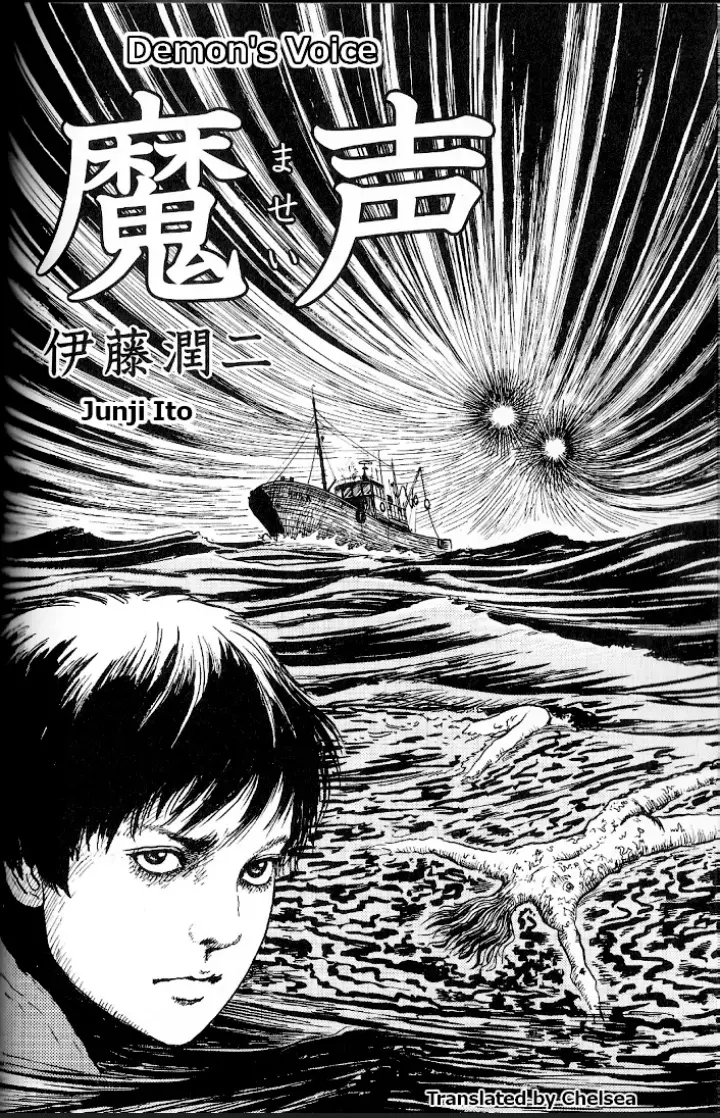
In Demon’s Voice, a group of fishermen are out on the open seas in search of Tuna. However, when they hear strange voices from across the ocean, very strange and disturbing things begin to happen.


Maybe it’s not a siren at all… maybe it’s the cry of a demon.

The voices begin to scare the crew — Demon’s Voice

Demon’s Voice — synopsis

Somewhere out in the middle of the ocean, a group of fishermen are scouting the open seas for a decent catch. It’s been a while since they have had a really good catch, but they continue on nonetheless — determined.

One night, whilst sailing across the deadly waves, a shrill cry is heard by the crew – what sounds like the voice; the voice of a demon. Luckily for one crew member, Koji, he happens to be inside the cabin with sea sickness when the voices begin.

The very next day, seemingly out of nowhere, the crew obtain the catch of their lives. In the nets they see masses of tuna; the biggest catch they could have ever imagined. Koji, however, sees what is really in those nets: a huge pile of rotting corpses pulled up out of the sea bed.

The crew, it seems, have started hallucinating – all except for Koji. The obvious cause seems to be the strange sounds from the night before. With Koji being ill in bed, he had failed to hear them. But what will happen once he hears them too? Once all of the crew are affected by those wailing sounds, what else will they end up dredging up from the ocean’s bed?

Characters

Thoughts on Demon’s Voice

A real mystery this one – a warning to sailors.

This seems to be inspired by the legends of the Sirens of the rocks – at least to me. The beautiful women who would lure sailors to their doom by sitting naked and playing sweet music. But in true Junji Ito style, we switch the sweet music for piercing night howls and naked ladies for rotting, horrifying corpses.

I always find the stories that are set in a single location interesting. It’s good to see how a writer crafts an engaging tale when working within a self-imposed limit like that. And Ito is as equipped as any of the best in doing so. The claustrophobia of the boat can be felt throughout, as can the imposing nature of the sea around them.

The idea of a small group of people being out on the open seas together is already a thought that could bring fears of isolation and the worry of having nowhere to turn for privacy. But when you throw in the idea of pulling up a load of old decaying corpses from the ocean floor, suddenly the great big ocean doesn’t feel so big any more.

Summary

Demon’s Voice is another short one shot story from Ito. The story is pretty straight forward and succinct. And like a lot of his shorter tales, packs a lot into its few pages.

He creates a world that could easily be further explored: What happens to this, and presumably other, crews? Where is this voice coming from? Why is there a malevolent force at work that is preying on innocent sailors.

I was reminded of another manga i’d read recently called “Mountain of Gods Precipice of the Unknown”. That too deals with an unknown force that is targeting a specific group of people. And for reasons unknown.

All in all, Demon’s Voice is a nice little story about the sirens in the ocean. Sail on.

The Bully

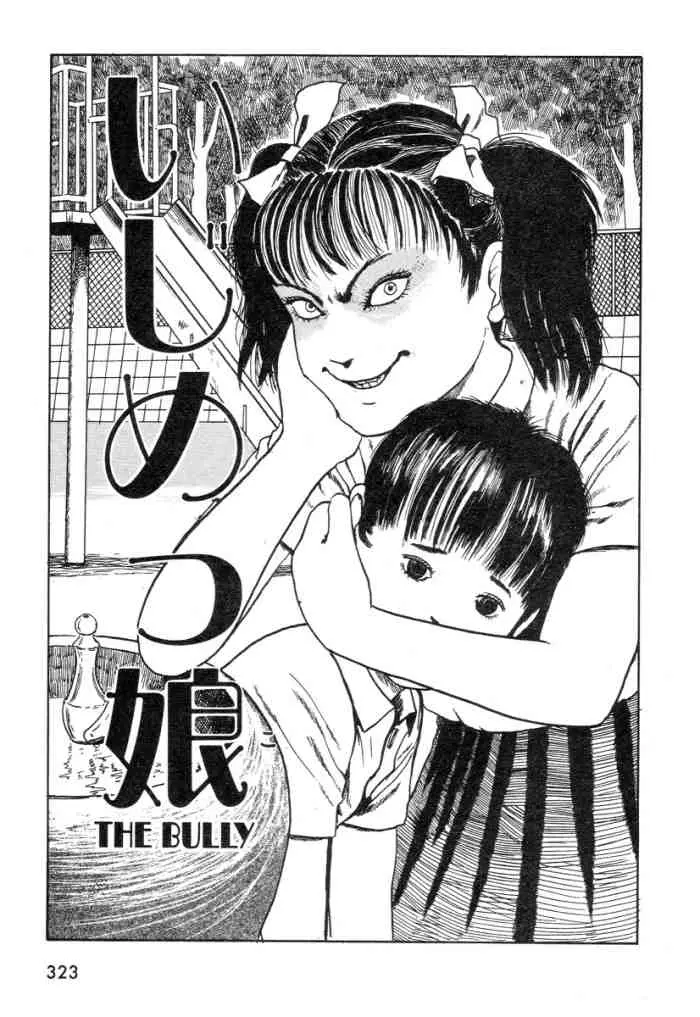
The Bully is one of those rare Junji Ito mangas that features no physical horror or gore. Instead, it’s horror is depicted through the bullying inflicted by the central character, Kuriko.

Synopsis: What is “The Bully” about?

In The Bully we follow Kuriko and the boys around her who end up suffering in one way or another. From the manga’s opening pages we are led to believe that she is a sweet woman who only wants to be honest with her husband-to-be.

We join Kuriko and her soon-to-be-Husband Yutaro at a local park, where they once played as children. She tells him how she wishes to confess details to him of her “dark past”, as she puts it. Kuriko tells him, and us through a flashback, of how she was once entrusted to look after a young boy, called Nao, when she was just a young girl herself.

But the trust put in her for that little boy’s welfare was misplaced, it seems. Kuriko goes on to reveal how, when Nao would start becoming too clingy with her, she would start bullying him. She started lightly with just screaming in his ear, but the story soon escalates her abuse into some pretty harsh scenes.

As the story of The Bully moves into it’s second half, it shows us how those earlier events have affected those people in the present day. We learn where those people are now in life and ultimately how Kuriko’s volatile nature affects each and every one of them.

Main Characters

A tough read at times

When we talk about horror with regards to Junji Ito, we often talk about the body horror aspects more often than not. We discuss slug-people, Spirals, and a certain girl who can not die. But in The Bully, Ito has crafted what I believe to be one of his most successfully-unnerving horror stories to date.

Although Kuriko is the main character here, I couldn’t help but empathise with Nao in those flashbacks. Where he was made to drink dirty water; where he was made to confront the scary dog “Devil”; and where he is beaten with a stick.

How Ito manages to bring to the page the horrors of being bullied is impressive. The innocent character of Nao was a perfect vessel in which we can put all of our hope and caring natures in to. Kuriko, on the other hand, was the perfect vessel for evil.

Although…

Kuriko is a bully to Nao

Kuriko is an interesting character

The fact that our introduction to Kuriko is at a point in life where she seems settled, and is opening up about her past, gave me a positive feeling about her. And just as negative first impressions can colour our image of people, I think positive ones can too.

Because of this, I found myself never really hating her, save for the dog scene and the beating. I found myself not liking her actions, but thinking about how we aren’t the same people as we were when we were younger. This doesn’t excuse those actions, but she is confessing through an apparent weight of guilt.

Of course in the story’s closing panels we do get to see her character transform into what she was perhaps destined to be. That closing panel of The Bully is one of the most frightening I have come across. Ito has always had a good eye for a great closing image that can haunt you, but this takes the prize.

Kuriko and Nao meet again

History repeats itself?

When stories take on the heavy subject of abuse, there are often times when the one who was abused later becomes the abuser to another. The cycle of violence. But something that I found very intriguing in The Bully, was that Junji Ito seemed to turn those ideas on their heads.

Kuriko seemed to have a nice family upbringing from what I could see in the flashbacks and yet something in her snapped at a young age. Then after being bullied relentlessly by her, Nao seemed to actually grow up to become a well-adjusted adult. He had a solid job and actually reminisced about his younger days with a kind of fondness. Love is blind, it seems.

But the story’s big reveal doesn’t show this violent nature being passed on to her child, but instead — and ultimately more terrifying — it shows Kuriko relapsing and unleashing a scarier version of her buried self.

Not only do we know what she was capable of as a child, but we know she is now a fully grown woman with the added strength that brings. And we know she is mentally unstable — mistaking her young son for the once-young Nao. But what we don’t know, is what ends up happened to her new victim. With it ending with a walk to the park, perhaps the real horror will live on in our minds trying to imagine what will happen next.

In Summary

The Bully has been getting recommended to me for a while now, and I never got round to reading it until recently. Now I see what all the fuss is about. This story is one of Junji Ito’s crowning achievements in my opinion. The way that he has developed each of the characters and gone against what you would perhaps have guessed would happen with them, is a stroke of genius.

Ito never takes the easy way out; he always pushes up to the boundaries and often past them. Despite him being one of the most accessible horror manga artists of our time, he remains one of the most terrifying and creative too.

If you want to jump into the deep end of horror manga but without all of the blood and guts, then Junji Ito’s The Bully is literally the perfect example of a story to read. It is also a self-contained one shot, standing at just 30 pages. So you could read this in one short go.

Futon

Futon is the first, and shortest, story in the Fragments of Horror Collection. It centers around a man who refuses to come out from under his blanket, for fear of the invisible spirits around him.

What is Futon about?

This is a very short Horror Manga story. It shows a young couple who live in a small apartment together. The Husband, Tomio, refuses to come out from under his blanket on his futon. The Futon is his bed.

He warns his wife of what he calls the “Dark Nature Spirits” in the room. She believes none of it until she actually gets a similar experience for herself.

But are these visions simply a manifestation of some extreme anxiety that Tomio is experiencing? Or are they as literal as he makes them out to be?

Short and Sweet

The story is very much to the point, yet no less charming than Ito’s other tales. Futon doesn’t try to fill out unneeded pages just to increase the count. Junji Ito has created a short horror story and isn’t afraid to just let it be what it is.

I absolutely love the big ceiling reveal that shows the monsters that Tomio is convinced he is seeing. The detail in that double-page spread is so great and a testament to Ito’s gorgeous horror style.

I was fine too with the vague back story that Tomio gives to his wife about the apparent witch. Some eerie tales can stand up for their strangeness alone, without the need for a comprehensive explanation. I think Futon is one such story.

In Summary

Despite it’s super short length at just eight pages, this is one of the Stories by the legendary Horror Mangaka that I remember more often. That double page spread is one that lives in my memory as vivid as the page itself.

I just hope I never get to see such visions off the page.

Honoured Ancestors

Honouring the memory of one’s ancestors is something that most people try to do – at least I like to think so. So it seems fitting that in Honoured Ancestors, Junji Ito should take this very human trait and turn the dial up to “weird” and give us a flesh and blood representation of ancestry.

What is Honoured Ancestors about?

We join a young couple as the boy, Makita, is walking his girlfriend Risa back to her house. Risa has recently lost her memory and nobody can work out how. She then begins to get increasing anxiety, along with nightmares of a giant caterpillar invading her bedroom at night.

Perhaps something in her lost memories can give a clue as to the origin of these disturbing visions?

Makita seems almost happy that Risa has lost her memory because, as he puts it, they can experience all of the “first times” they had together once again. One such “first time” that they relive is them both going round to Makita’s home, where he lives with his sick father. However, upon meeting the father, thoughts and feelings begin to stir within her.

It is in this house where the mystery of her lost memories will be unravelled. And there will be one such “first time” that she will wish would never happen again.

Head to head with the past

In the author’s notes for this story, Ito explains how he saw the big reveal of this story in his mind before any of characters or plot came to him. This is a very interesting way of working, starting with the imagery and working back from there, and I wonder how many other stories of his began this way.

Honoured Ancestors is one of those stories that has so much more going on underneath its surface than what we see. We are shown the current generation of the family, Makita, along with the end of his father’s life. But what about the many ancestors that came before? How did they all trick their partners into marriage and carrying on this family line in such a twisted way?

I really enjoy how many of Ito’s stories like this one trigger these thoughts in me. I love wondering about events that happened so completely out of the scope of the current story, yet would still have had an effect on the story’s world.

In Summary

I enjoy this story a lot. While not being a favourite of mine, it still holds a high place for me. I find myself imagining the lives of those ancestors and just how they came to begin the connection to their past in this way.

You should definitely pick up Junji Ito’s Shiver Collection and read this story – see what thoughts it sparks in your own imagination.

Fashion Model : Cursed Frame

Fuchi the model is back in this short manga story, included with the excellent Shiver collection. A timid new model crosses paths with Fuchi with very violent and creative results.


Ever since I was little, I’ve been afraid of having my picture taken. Or more precisely, of my body being fragmented by photos.

Amy is a fresh young model with a strange phobia — Fashion Model: Cursed Frame

In this bonus story from his Shiver collection, Junji Ito delivers an incredible depiction of a woman’s strange fear made flesh. And in the most iconic of ways too. One of the things about Junji Ito that is so great, is his big reveals that he often gives us. More often than not I don’t expect them. However, in hindsight they seem to be the only logical outcome.

Logical in Ito’s world at least.

What is Fashion Model Cursed Frame about?

In Fashion Model: Cursed Frame, we are reunited with a favourite amongst Ito’s Characters – Fuchi. Fuchi is the shark-toothed, seven-foot-tall fashion model with a taste for human flesh.

The modelling industry in Junji Ito’s world is very cut-throat indeed.

Amy is a new model on the scene, who agrees to work for a company on a single condition – that they only ever photograph her full body. Never head or body shots. The idea of having parts of her body missing from photographs completely freaks her out.

It is the kind of fear that feels right at home in Junji Ito’s world. And I could just tell it wasn’t going to end well for her.

But how will Amy cope in a profession where people don’t stick to their word. An industry that is often depicted as being ruthless and super-competitive. Not to mention the demonic Fuchi lurking about; on the prowl within those choppy waters of the fashion world.

In Summary

Cursed Frame is only seven pages long and comes as a bonus in the back of the Junji Ito Shiver Collection. But despite its short length, it packs so much into those pages in a concise, and suitably violent way.

I was really impressed at how he gave us a character with a very specific fear – and one I’d never heard of before either – and managed to bring her story full circle to face that fear head on. I thought Fuchi was an excellent conduit for the idea too – her presence alone brings a sense of dread and foreboding.

I really wish Fuchi was more of a long-standing character – she’s so much fun to watch.